FAIR USE NOTICE

FAIR USE NOTICE

A BEAR MARKET ECONOMICS BLOG

OCCUPY EVERYTHING

This site may contain copyrighted material the use of which has not always been specifically authorized by the copyright owner. We are making such material available in an effort to advance understanding of environmental, political, human rights, economic, democracy, scientific, and social justice issues, etc. we believe this constitutes a ‘fair use’ of any such copyrighted material as provided for in section 107 of the US Copyright Law.

In accordance with Title 17 U.S.C. Section 107, the material on this site is distributed without profit to those who have expressed a prior interest in receiving the included information for research and educational purposes. For more information go to: http://www.law.cornell.edu/uscode/17/107.shtml

If you wish to use copyrighted material from this site for purposes of your own that go beyond ‘fair use’, you must obtain permission from the copyright owner.

FAIR USE NOTICE FAIR USE NOTICE: This page may contain copyrighted material the use of which has not been specifically authorized by the copyright owner. This website distributes this material without profit to those who have expressed a prior interest in receiving the included information for scientific, research and educational purposes. We believe this constitutes a fair use of any such copyrighted material as provided for in 17 U.S.C § 107.

Read more at: http://www.etupdates.com/fair-use-notice/#.UpzWQRL3l5M | ET. Updates
FAIR USE NOTICE FAIR USE NOTICE: This page may contain copyrighted material the use of which has not been specifically authorized by the copyright owner. This website distributes this material without profit to those who have expressed a prior interest in receiving the included information for scientific, research and educational purposes. We believe this constitutes a fair use of any such copyrighted material as provided for in 17 U.S.C § 107.

Read more at: http://www.etupdates.com/fair-use-notice/#.UpzWQRL3l5M | ET. Updates

All Blogs licensed under Creative Commons Attribution 3.0

Creative Commons License
This work is licensed under a Creative Commons Attribution 3.0 Unported License.

Friday, March 4, 2016

What Makes People Vote Republican?


To arrive at the edge of the world's knowledge, seek out the most complex and sophisticated minds, put them in a room together, and have them ask each other the questions they are asking themselves.


...the second rule of moral psychology is that morality is not just about how we treat each other (as most liberals think); it is also about binding groups together, supporting essential institutions, and living in a sanctified and noble way. When Republicans say that Democrats "just don't get it," this is the "it" to which they refer.
JONATHAN HAIDT is Associate Professor of Psychology at the University of Virginia, where he does research on morality and emotion and how they vary across cultures. He is the author of The Happiness Hypothesis: Finding Modern Truth in Ancient Wisdom.
Further reading on Edge: Moral Psychology and the Misunderstanding of Religion By Jonathan Haidt [9.22.07]
THE REALITY CLUB: Daniel Everett, Howard Gardner, Michael Shermer, Scott Atran, James Fowler, Alison Gopnik, Sam Harris, James O'Donnell
 

WHAT MAKES PEOPLE VOTE REPUBLICAN?

What makes people vote Republican? Why in particular do working class and rural Americans usually vote for pro-business Republicans when their economic interests would seem better served by Democratic policies? We psychologists have been examining the origins of ideology ever since Hitler sent us Germany's best psychologists, and we long ago reported that strict parenting and a variety of personal insecurities work together to turn people against liberalism, diversity, and progress. But now that we can map the brains, genes, and unconscious attitudes of conservatives, we have refined our diagnosis: conservatism is a partially heritable personality trait that predisposes some people to be cognitively inflexible, fond of hierarchy, and inordinately afraid of uncertainty, change, and death. People vote Republican because Republicans offer "moral clarity"—a simple vision of good and evil that activates deep seated fears in much of the electorate. Democrats, in contrast, appeal to reason with their long-winded explorations of policy options for a complex world.
Diagnosis is a pleasure. It is a thrill to solve a mystery from scattered clues, and it is empowering to know what makes others tick. In the psychological community, where almost all of us are politically liberal, our diagnosis of conservatism gives us the additional pleasure of shared righteous anger. We can explain how Republicans exploit frames, phrases, and fears to trick Americans into supporting policies (such as the "war on terror" and repeal of the "death tax") that damage the national interest for partisan advantage.
But with pleasure comes seduction, and with righteous pleasure comes seduction wearing a halo. Our diagnosis explains away Republican successes while convincing us and our fellow liberals that we hold the moral high ground. Our diagnosis tells us that we have nothing to learn from other ideologies, and it blinds us to what I think is one of the main reasons that so many Americans voted Republican over the last 30 years: they honestly prefer the Republican vision of a moral order to the one offered by Democrats. To see what Democrats have been missing, it helps to take off the halo, step back for a moment, and think about what morality really is.
________________

I began to study morality and culture at the University of Pennsylvania in 1987. A then-prevalent definition of the moral domain, from the Berkeley psychologist Elliot Turiel, said that morality refers to "prescriptive judgments of justice, rights, and welfare pertaining to how people ought to relate to each other." But if morality is about how we treat each other, then why did so many ancient texts devote so much space to rules about menstruation, who can eat what, and who can have sex with whom? There is no rational or health-related way to explain these laws. (Why are grasshoppers kosher but most locusts are not?) The emotion of disgust seemed to me like a more promising explanatory principle. The book of Leviticus makes a lot more sense when you think of ancient lawgivers first sorting everything into two categories: "disgusts me" (gay male sex, menstruation, pigs, swarming insects) and "disgusts me less" (gay female sex, urination, cows, grasshoppers ).
For my dissertation research, I made up stories about people who did things that were disgusting or disrespectful yet perfectly harmless. For example, what do you think about a woman who can't find any rags in her house so she cuts up an old American flag and uses the pieces to clean her toilet, in private? Or how about a family whose dog is killed by a car, so they dismember the body and cook it for dinner? I read these stories to 180 young adults and 180 eleven-year-old children, half from higher social classes and half from lower, in the USA and in Brazil. I found that most of the people I interviewed said that the actions in these stories were morally wrong, even when nobody was harmed. Only one group—college students at Penn—consistently exemplified Turiel's definition of morality and overrode their own feelings of disgust to say that harmless acts were not wrong. (A few even praised the efficiency of recycling the flag and the dog).
This research led me to two conclusions. First, when gut feelings are present, dispassionate reasoning is rare. In fact, many people struggled to fabricate harmful consequences that could justify their gut-based condemnation. I often had to correct people when they said things like "it's wrong because… um…eating dog meat would make you sick" or "it's wrong to use the flag because… um… the rags might clog the toilet." These obviously post-hoc rationalizations illustrate the philosopher David Hume's dictum that reason is "the slave of the passions, and can pretend to no other office than to serve and obey them." This is the first rule of moral psychology: feelings come first and tilt the mental playing field on which reasons and arguments compete. If people want to reach a conclusion, they can usually find a way to do so. The Democrats have historically failed to grasp this rule, choosing uninspiring and aloof candidates who thought that policy arguments were forms of persuasion.
The second conclusion was that the moral domain varies across cultures. Turiel's description of morality as being about justice, rights, and human welfare worked perfectly for the college students I interviewed at Penn, but it simply did not capture the moral concerns of the less elite groups—the working-class people in both countries who were more likely to justify their judgments with talk about respect, duty, and family roles. ("Your dog is family, and you just don't eat family.") From this study I concluded that the anthropologist Richard Shweder was probably right in a 1987 critique of Turiel in which he claimed that the moral domain (not just specific rules) varies by culture. Drawing on Shweder's ideas, I would say that the second rule of moral psychology is that morality is not just about how we treat each other (as most liberals think); it is also about binding groups together, supporting essential institutions, and living in a sanctified and noble way.
When Republicans say that Democrats "just don't get it," this is the "it" to which they refer. Conservative positions on gays, guns, god, and immigration must be understood as means to achieve one kind of morally ordered society. When Democrats try to explain away these positions using pop psychology they err, they alienate, and they earn the label "elitist." But how can Democrats learn to see—let alone respect—a moral order they regard as narrow-minded, racist, and dumb?
________________
After graduate school I moved to the University of Chicago to work with Shweder, and while there I got a fellowship to do research in India. In September 1993 I traveled to Bhubaneswar, an ancient temple town 200 miles southwest of Calcutta. I brought with me two incompatible identities. On the one hand, I was a 29 year old liberal atheist who had spent his politically conscious life despising Republican presidents, and I was charged up by the culture wars that intensified in the 1990s. On the other hand, I wanted to be like those tolerant anthropologists I had read so much about.
My first few weeks in Bhubaneswar were therefore filled with feelings of shock and confusion. I dined with men whose wives silently served us and then retreated to the kitchen. My hosts gave me a servant of my own and told me to stop thanking him when he served me. I watched people bathe in and cook with visibly polluted water that was held to be sacred. In short, I was immersed in a sex-segregated, hierarchically stratified, devoutly religious society, and I was committed to understanding it on its own terms, not on mine.
It only took a few weeks for my shock to disappear, not because I was a natural anthropologist but because the normal human capacity for empathy kicked in. I liked these people who were hosting me, helping me, and teaching me. And once I liked them (remember that first principle of moral psychology) it was easy to take their perspective and to consider with an open mind the virtues they thought they were enacting. Rather than automatically rejecting the men as sexist oppressors and pitying the women, children, and servants as helpless victims, I was able to see a moral world in which families, not individuals, are the basic unit of society, and the members of each extended family (including its servants) are intensely interdependent. In this world, equality and personal autonomy were not sacred values. Honoring elders, gods, and guests, and fulfilling one's role-based duties, were more important. Looking at America from this vantage point, what I saw now seemed overly individualistic and self-focused. For example, when I boarded the plane to fly back to Chicago I heard a loud voice saying "Look, you tell him that this is the compartment over MY seat, and I have a RIGHT to use it."
Back in the United States the culture war was going strong, but I had lost my righteous passion. I could never have empathized with the Christian Right directly, but once I had stood outside of my home morality, once I had tried on the moral lenses of my Indian friends and interview subjects, I was able to think about conservative ideas with a newfound clinical detachment. They want more prayer and spanking in schools, and less sex education and access to abortion? I didn't think those steps would reduce AIDS and teen pregnancy, but I could see why the religious right wanted to "thicken up" the moral climate of schools and discourage the view that children should be as free as possible to act on their desires. Conservatives think that welfare programs and feminism increase rates of single motherhood and weaken the traditional social structures that compel men to support their own children? Hmm, that may be true, even if there are also many good effects of liberating women from dependence on men. I had escaped from my prior partisan mindset (reject first, ask rhetorical questions later), and began to think about liberal and conservative policies as manifestations of deeply conflicting but equally heartfelt visions of the good society.
________________

On Turiel's definition of morality ("justice, rights, and welfare"), Christian and Hindu communities don't look good. They restrict people's rights (especially sexual rights), encourage hierarchy and conformity to gender roles, and make people spend extraordinary amounts of time in prayer and ritual practices that seem to have nothing to do with "real" morality. But isn't it unfair to impose on all cultures a definition of morality drawn from the European Enlightenment tradition? Might we do better with an approach that defines moral systems by what they do rather than by what they value?
Here's my alternative definition: morality is any system of interlocking values, practices, institutions, and psychological mechanisms that work together to suppress or regulate selfishness and make social life possible. It turns out that human societies have found several radically different approaches to suppressing selfishness, two of which are most relevant for understanding what Democrats don't understand about morality.
First, imagine society as a social contract invented for our mutual benefit. All individuals are equal, and all should be left as free as possible to move, develop talents, and form relationships as they please. The patron saint of a contractual society is John Stuart Mill, who wrote (in On Liberty) that "the only purpose for which power can be rightfully exercised over any member of a civilized community, against his will, is to prevent harm to others." Mill's vision appeals to many liberals and libertarians; a Millian society at its best would be a peaceful, open, and creative place where diverse individuals respect each other's rights and band together voluntarily (as in Obama's calls for "unity") to help those in need or to change the laws for the common good.
Psychologists have done extensive research on the moral mechanisms that are presupposed in a Millian society, and there are two that appear to be partly innate. First, people in all cultures are emotionally responsive to suffering and harm, particularly violent harm, and so nearly all cultures have norms or laws to protect individuals and to encourage care for the most vulnerable. Second, people in all cultures are emotionally responsive to issues of fairness and reciprocity, which often expand into notions of rights and justice. Philosophical efforts to justify liberal democracies and egalitarian social contracts invariably rely heavily on intuitions about fairness and reciprocity.
But now imagine society not as an agreement among individuals but as something that emerged organically over time as people found ways of living together, binding themselves to each other, suppressing each other's selfishness, and punishing the deviants and free-riders who eternally threaten to undermine cooperative groups. The basic social unit is not the individual, it is the hierarchically structured family, which serves as a model for other institutions. Individuals in such societies are born into strong and constraining relationships that profoundly limit their autonomy. The patron saint of this more binding moral system is the sociologist Emile Durkheim, who warned of the dangers of anomie (normlessness), and wrote, in 1897, that "Man cannot become attached to higher aims and submit to a rule if he sees nothing above him to which he belongs. To free himself from all social pressure is to abandon himself and demoralize him." A Durkheimian society at its best would be a stable network composed of many nested and overlapping groups that socialize, reshape, and care for individuals who, if left to their own devices, would pursue shallow, carnal, and selfish pleasures. A Durkheimian society would value self-control over self-expression, duty over rights, and loyalty to one's groups over concerns for outgroups.
A Durkheimian ethos can't be supported by the two moral foundations that hold up a Millian society (harm/care and fairness/reciprocity). My recent research shows that social conservatives do indeed rely upon those two foundations, but they also value virtues related to three additional psychological systems: ingroup/loyalty (involving mechanisms that evolved during the long human history of tribalism), authority/respect (involving ancient primate mechanisms for managing social rank, tempered by the obligation of superiors to protect and provide for subordinates), and purity/sanctity (a relatively new part of the moral mind, related to the evolution of disgust, that makes us see carnality as degrading and renunciation as noble). These three systems support moralities that bind people into intensely interdependent groups that work together to reach common goals. Such moralities make it easier for individuals to forget themselves and coalesce temporarily into hives, a process that is thrilling, as anyone who has ever "lost" him or herself in a choir, protest march, or religious ritual can attest.
In several large internet surveys, my collaborators Jesse Graham, Brian Nosek and I have found that people who call themselves strongly liberal endorse statements related to the harm/care and fairness/reciprocity foundations, and they largely reject statements related to ingroup/loyalty, authority/respect, and purity/sanctity. People who call themselves strongly conservative, in contrast, endorse statements related to all five foundations more or less equally. (You can test yourself at www.YourMorals.org.) We think of the moral mind as being like an audio equalizer, with five slider switches for different parts of the moral spectrum. Democrats generally use a much smaller part of the spectrum than do Republicans. The resulting music may sound beautiful to other Democrats, but it sounds thin and incomplete to many of the swing voters that left the party in the 1980s, and whom the Democrats must recapture if they want to produce a lasting political realignment.
________________

In The Political Brain, Drew Westen points out that the Republicans have become the party of the sacred, appropriating not just the issues of God, faith, and religion, but also the sacred symbols of the nation such as the Flag and the military. The Democrats, in the process, have become the party of the profane—of secular life and material interests. Democrats often seem to think of voters as consumers; they rely on polls to choose a set of policy positions that will convince 51% of the electorate to buy. Most Democrats don't understand that politics is more like religion than it is like shopping.
Religion and political leadership are so intertwined across eras and cultures because they are about the same thing: performing the miracle of converting unrelated individuals into a group. Durkheim long ago said that God is really society projected up into the heavens, a collective delusion that enables collectives to exist, suppress selfishness, and endure. The three Durkheimian foundations (ingroup, authority, and purity) play a crucial role in most religions. When they are banished entirely from political life, what remains is a nation of individuals striving to maximize utility while respecting the rules. What remains is a cold but fair social contract, which can easily degenerate into a nation of shoppers.
The Democrats must find a way to close the sacredness gap that goes beyond occasional and strategic uses of the words "God" and "faith." But if Durkheim is right, then sacredness is really about society and its collective concerns. God is useful but not necessary. The Democrats could close much of the gap if they simply learned to see society not just as a collection of individuals—each with a panoply of rights--but as an entity in itself, an entity that needs some tending and caring. Our national motto is e pluribus unum ("from many, one"). Whenever Democrats support policies that weaken the integrity and identity of the collective (such as multiculturalism, bilingualism, and immigration), they show that they care more about pluribus than unum. They widen the sacredness gap.
A useful heuristic would be to think about each issue, and about the Party itself, from the perspective of the three Durkheimian foundations. Might the Democrats expand their moral range without betraying their principles? Might they even find ways to improve their policies by incorporating and publicly praising some conservative insights?
The ingroup/loyalty foundation supports virtues of patriotism and self-sacrifice that can lead to dangerous nationalism, but in moderate doses a sense that "we are all one" is a recipe for high social capital and civic well-being. A recent study by Robert Putnam (titled E Pluribus Unum) found that ethnic diversity increases anomie and social isolation by decreasing people's sense of belonging to a shared community. Democrats should think carefully, therefore, about why they celebrate diversity. If the purpose of diversity programs is to fight racism and discrimination (worthy goals based on fairness concerns), then these goals might be better served by encouraging assimilation and a sense of shared identity.
The purity/sanctity foundation is used heavily by the Christian right to condemn hedonism and sexual "deviance," but it can also be harnessed for progressive causes. Sanctity does not have to come from God; the psychology of this system is about overcoming our lower, grasping, carnal selves in order to live in a way that is higher, nobler, and more spiritual. Many liberals criticize the crassness and ugliness that our unrestrained free-market society has created. There is a long tradition of liberal anti-materialism often linked to a reverence for nature. Environmental and animal welfare issues are easily promoted using the language of harm/care, but such appeals might be more effective when supplemented with hints of purity/sanctity.
The authority/respect foundation will be the hardest for Democrats to use. But even as liberal bumper stickers urge us to "question authority" and assert that "dissent is patriotic," Democrats can ask what needs this foundation serves, and then look for other ways to meet them. The authority foundation is all about maintaining social order, so any candidate seen to be "soft on crime" has disqualified himself, for many Americans, from being entrusted with the ultimate authority. Democrats would do well to read Durkheim and think about the quasi-religious importance of the criminal justice system. The miracle of turning individuals into groups can only be performed by groups that impose costs on cheaters and slackers. You can do this the authoritarian way (with strict rules and harsh penalties) or you can do it using the fairness/reciprocity foundation by stressing personal responsibility and the beneficence of the nation towards those who "work hard and play by the rules." But if you don't do it at all—if you seem to tolerate or enable cheaters and slackers -- then you are committing a kind of sacrilege.
________________

If Democrats want to understand what makes people vote Republican, they must first understand the full spectrum of American moral concerns. They should then consider whether they can use more of that spectrum themselves. The Democrats would lose their souls if they ever abandoned their commitment to social justice, but social justice is about getting fair relationships among the parts of the nation. This often divisive struggle among the parts must be balanced by a clear and oft-repeated commitment to guarding the precious coherence of the whole. America lacks the long history, small size, ethnic homogeneity, and soccer mania that holds many other nations together, so our flag, our founding fathers, our military, and our common language take on a moral importance that many liberals find hard to fathom.
Unity is not the great need of the hour, it is the eternal struggle of our immigrant nation. The three Durkheimian foundations of ingroup, authority, and purity are powerful tools in that struggle. Until Democrats understand this point, they will be vulnerable to the seductive but false belief that Americans vote for Republicans primarily because they have been duped into doing so.

Monday, February 29, 2016

It’s their party and they’ll do what they want to, Part Now


It’s their party and they’ll do what they want to


Whether they win the nomination or not, the campaigns of Donald Trump and Bernie Sanders have stunned the political world by bucking the Republican and Democratic party establishments and scoring electoral success as outsiders.
Should they continue their successes and both score wins in each of their parties’ caucuses and primaries, it is entirely possible for the Republican and Democratic parties to deny them the nominations.
It is something that is not without precedent.
In 1986, then-Alabama Lt. Gov. Bill Baxley ran against then-Alabama Attorney General Charlie Graddick for the Democratic Party’s nod for governor.
At that time in statewide elections Alabama was still a one-party Democratic state, but there was a clear conservative-liberal ideological division within the party, which was on display in the 1986 election.
The left plank of the Democratic Party at the time supported Baxley and the right supported Graddick.
The voter turnout that year proved Alabama was even more of a one-party state than it is now. In the 1986 election cycle, the Democratic Party primary had a turnout of more than 800,000 voters while the Republican Party primary drew 40,000.
Unknown Cullman County Probate Judge Guy Hunt cruised to the GOP nomination while Graddick and Baxley fought it out.
Graddick won the Democratic primary, but the party ultimately granted Baxley the nomination because the Democratic establishment at the time saw Graddick as unworthy of the party’s nod. Their argument was that Graddick won as a result of Republican crossover voters in the Democratic Party. Graddick even took the battle to federal court, but lost.
While Graddick lost the fight, its aftermath was arguably worse for Alabama Democrats.
Later that year, Alabama elected Guy Hunt in the general election, the state’s first Republican governor in a century. Many blamed the outcome of that election on the shenanigans the Democratic Party played in the nomination.
Fast-forward 30 years.
As of last week’s Nevada caucus, Sen. Bernie Sanders (I-Vermont) has received 151,584 votes when combining the Iowa, New Hampshire and Nevada outcomes, while Hillary Clinton has received 95,252 of those votes. However, the delegate count as of now is firmly on Clinton’s side by a margin of 502-70. The bulk of Clinton’s lead is composed of super delegates, which are unelected delegates free to support either candidate, by a margin of 451 for Clinton to 19 for Sanders.
On the GOP side of the presidential election it’s also possible the party could tip the scales against Trump.
The idea of an outsider like Trump winning the Republican nod is repulsive to a lot of the party’s long-time establishment. They loathe the thought of a “short-fingered vulgarian” from Queens carrying their party’s banner.
That conflict sets itself up for an ugly fight heading to the GOP’s convention in Cleveland, Ohio, later this year, even if Trump continues his winning streak throughout the primary process.
So, it’s not out of the realm of possibility for both parties to nominate a candidate who did not win the popular vote nationally in primaries. And if it happens, there’s probably not much anyone can do about it.
While the parties would be acting at their own peril, there’s a legitimate argument to be made against Trump and Sanders.
Although Bernie Sanders caucuses with the Democrats in the U.S. Senate, he has always run as an independent candidate, going back to his days as mayor of Burlington, Vermont, including running in some elections against a Democratic candidate.
There’s an argument to be made that Sanders was never willing to be a Democrat until this presidential election, so why give him the party’s most important nomination?
The same goes for Trump.
One of the big knocks on Trump is he has supported Democrats for many years. Up until 2011, Trump had contributed evenly between Democrats and Republicans. But from 2012 forward, he has given overwhelmingly to Republican candidates.
But the fact that he donated to both the Democratic Congressional Campaign Committee and the Democratic Senatorial Campaign Committee and to the senatorial campaigns of Hillary Clinton and Harry Reid is a disqualifier in the minds of much of country’s Republican hierarchy.
If either scenario happens, where the Republicans or Democrats buck their respective party’s popular vote, there probably isn’t much anyone can do about it.
It’s sure to be litigated in the courts, but the Republican and Democratic parties are not necessarily beholden to the voters in picking their presidential nominee. There is not a constitutional right for a candidate to receive a political party’s nod.
It isn’t out of the realm of possibility for the parties to say, “Screw the vote, we’re going to do what we want. We don’t want a repeat of George McGovern or Barry Goldwater, so we’re going to do what we think is in our best interests. Trump and Sanders have never done anything for our parties’ apparatuses, so why should we reward them with our party’s nomination?”
If it happens, it does have the potential to backfire on the two parties. It sets up a situation where one of the candidates would benefit from the backlash of the opposing party.
But what if both parties opt to go against the will of the voters and both select candidates that did not win the popular votes of the parties? It’s entirely possible if one does it, the other will see it as cover to do the same and voters in both primaries will be disenfranchised.
If that happens, be prepared for a voter revolt and the rise of multiple political parties beyond just the Democratic and Republican parties we have today.

Monday, February 15, 2016

Antonin Scalia: Forefather of Modern Republican Nihilism


News & Politics
Antonin Scalia wasn't just a giant of conservative jurisprudence. He was an architect of right-wing legal extremism.


Supreme Court Justice Antonin Scalia, pictured last year, denied Wednesday falling out with the top US court's chief justice over his shock decision to back President Barack Obama's health reform law

It’s ironic, to say the least, that the passing of Justice Antonin Scalia, a man known for the legal doctrine of “originalism,” would immediately lead the majority leader of the Senate to declare that no nominee to replace him would be confirmed until a new president is inaugurated in a year’s time. The founders would very likely scratch their heads in wonder at Mitch McConnell’s odd statement that “the American people should have a voice in the selection of their next Supreme Court Justice, therefore this vacancy should not be filled until we have a new president.” They would likely point out that the American people did have a voice in that decision in 2012, when they voted for Barack Obama for a four year term. There’s nothing in the Constitution that says after three years the president is no longer authorized to nominate Supreme Court Justices.

Be that as it may, the reality is the Republican Senate is not going to confirm anyone President Obama sends up, and I don’t think anyone would imagine otherwise. What’s startling about McConnell’s statement is the fact that he said it so openly. It’s another example of the reckless disregard of political norms, traditions and the rule of law by the modern GOP. In the old days, they would have at least paid lip service to the idea that a president is obligated to nominate Supreme Court justices and the Senate is obligated to fulfill its advise-and-consent role. Sure, they would delay the nomination, but to just announce upfront that they have no intention of following the usual procedure is a new thing. They don’t even pretend to care about preserving the integrity of the institution.

Last night in the GOP debate, all the candidates backed up McConnell. It would seem they too believe that even the pretense of normal constitutional processes is no longer necessary. This will be good to keep in mind as they bray incessantly about President Obama’s use of executive orders as if they were acts of treason. (By the way, his use of Executive Orders is right in line with all modern presidents, including Republicans.)

But then, if there’s one Supreme Court justice who exemplifies this propensity of modern American conservatives to bend the system for partisan ends when needed, it was Justice Antonin Scalia. His legacy as a hardcore legal conservative is second to none, but it will always be over-shadowed by one decision: Bush v. Gore. The Republicans had already begun the process of destroying the integrity of Congress with its partisan witch hunts and the impeachment circus of the 1990s; but if there’s one Supreme Court ruling that paved the way for the total abandonment of any pretense of dignified non-partisan adherence to traditions for the sake of preserving the integrity of our institutions in the eyes of the public, it is that one.

Indeed, Justice Scalia may have written the single most fatuous line in Supreme Court history with his brief concurrence in that case:
“The counting of votes that are of questionable legality does in my view threaten irreparable harm [George W. Bush] and to the country, by casting a cloud upon what he claims to be the legitimacy of his election.”
 Scalia was a very smart man, and he had to know that this would be one of the main decisions for which he was remembered. His willingness to risk his reputation by writing that ridiculous rationale for a nakedly partisan outcome served as an example to conservatives everywhere: Win by any means necessary.
He did not like being reminded of it. When college audiences would ask him about the decision he would usually bellow, “Get over it,” which was the standard line the media employed in the wake of the decision in 2000. But in recent years he led the way with another modern Republican tactic, simply denying reality. In 2008 he appeared on “60 Minutes”:
“People say that that decision was not based on judicial philosophy but on politics,” Stahl asks.
“I say nonsense,” Scalia says.
Was it political?
“Gee, I really don’t wanna get into – I mean this is – get over it. It’s so old by now. The principal issue in the case, whether the scheme that the Florida Supreme Court had put together violated the federal Constitution, that wasn’t even close. The vote was seven to two.”
In 2012, he said the same thing at Wesleyan University:
At the end of the speech, Scalia took questions from the audience. One person asked about the Bush-Gore case, where the Supreme Court had to determine the winner of the election.
“Get over it,” Scalia said of the controversy surrounding it, to laughter from the audience.“
Scalia reminded the audience it was Gore who took the election to court, and the election was going to be decided in a court anyway—either the Florida Supreme Court or the U.S. Supreme Court.
It was a long time ago, people forget…It was a 7-2 decision. It wasn’t even close,” he said.
The problem is that he was not telling the truth. As Ian Millhiser at Think Progress explained:
Bush v. Gore was not a 7-2 decision — and indeed, Scalia could tell this is true by counting all four of the dissenting opinions in that case. Although it is true that the four dissenters divided on how the Florida recount should proceed — two believed there should be a statewide recount of all Florida voters while two others believed a narrower recount would be acceptable — not one of the Court’s four moderates agreed with Scalia that the winner of the 2000 presidential election should effectively be chosen by five most conservative members of the Supreme Court of the United States.
Justice Scalia had a long illustrious judicial career. He was a giant among the modern conservative legal theorists on the right.  But he was also one of the fathers of the modern conservative movement’s “you can believe me or you can believe your lying eyes” school of politics. If the 2016 Republican presidential primary is any example, his political legacy is secure.

Heather Digby Parton, also known as "Digby," is a contributing writer to Salon. She was the winner of the 2014 Hillman Prize for Opinion and Analysis Journalism.

Monday, February 8, 2016

It Is Paul Krugman Who Lives in a Fantasy World, Not Bernie Supporters


Home


ELECTION 2016
Krugman wants people to be rational and pragmatic like he is. They aren't—and sometimes that is a good thing.

Photo Credit: Prolineserver / Wikimedia Commons
Nobel Laureate Paul Krugman can’t stand that people are irrational; that working-class conservatives are duped into voting against their own economic interests. In a recent New York Times editorial called "How Change Happens," Krugman complained that liberal Bernie Sanders supporters are hopelessly waiting for the “better angels” in people to rise up and radically change our corrupt institutions. Real change, he argues, requires rational pragmatism and compromise.
As a psychotherapist who writes about politics, I have a different issue: I can’t believe Krugman is bewildered by the fact that the quality and quantity of our political engagement is strongly shaped by powerful unconscious needs and fears that are relatively immune to rational argument. Forgetting for a moment that, as others have pointed out, he misrepresents Sanders’ view of change. Krugman’s own view reflects a wishful fantasy that fundamental social change results from incremental victories that reflect rational compromises between competing interests. But the fundamental issue facing progressives today is not one negotiated by policy wonks; it is how we can build healthy institutions that become a base for a radical social movement. The issue is how do we engage the passions of millions of Americans who view such a movement as connecting to their unrequited desires and unarticulated fears? 
To do so, we have to at least start with an accurate view of human motivation; that is, our picture of what people really need and fear, and therefore, how the institutions we build and the ideology we promote speak to these feelings at the deepest possible level. For example, people in our society are often isolated and lonely. People need a feeling of connectedness as much as they need economic justice. How does our “message” offer people a sense of community? (Sanders’ enthusiastic calls for a “political revolution” seek to do just that, while Clinton hangs her appeal on flat and technocratic notions of “competence.”) The right has certainly understood people’s frustrated needs for connectedness, although their offer of “community” is based in large part of demonizing some other (immigrants, gays, welfare recipients, etc.). 
Or consider the notion Krugman gently mocks that too many progressives are trying to conjure up the better angels of America’s nature. In fact, people do have a deep emotional longing for meaning and purpose. We want our better angels to be awakened and we want to see the same in others. All one has to do to see this need awakened is to note how communities react with altruistic and high-minded generosity in the wake of natural or man-made disasters.
Politicians act when they are forced to or bribed to act. The compromises that so often result are due to the net effect of this play of forces. The job of progressives is to strengthen our side, increase our power, by engaging and inspiring people out of their passivity, not just by offering up reasonable policy alternatives but by inspiring them to be bigger and better than they typically see themselves.  That’s what Obama did in 2008, and it’s what Sanders is doing now.
Sanders’ appeal isn’t reducible to what Krugman calls “transformational rhetoric,” but is, instead, an antidote to the cynicism so prevalent today, a malignant despair that doesn’t arise from the stupidity of conservatives or the naïve idealism of progressives.  Cynicism is the belief that the way things are is the way they’re supposed to be. It can’t be combatted simply by appeals to reason, but rather, by speaking to the hearts of our constituents, stimulating (not belittling) their belief in better angels and resonating with their needs for love, recognition, agency, community, and meaning. These apparently softer needs are every bit as powerful as rational economic self-interest or left-brain logic. 
Paul Krugman is the leading public intellectual in America today. He stands head and shoulders above the dishonest and small-minded wonks and politicians on the right. When he crosses swords with them, we are the better for it. But if he wants to talk about how change occurs and about political compromise, he needs to understand that Roosevelt was pushed to the left by labor, LBJ by the civil rights movement, Nixon by the anti-war movement, and the Supreme Court by the LGBT movement for same-sex marriage. Radical social change can’t be understood as the result of technical policy compromises between rational actors, but rather as the result of social movements that acquire power by engaging the whole person—including the more intimate regions of the heart and soul, as well as the parts in which reason resides.
Contrary to Krugman’s assertion, we will need those "better angels of our nature” in order to win the power needed to be pragmatic from a position of strength. Otherwise, pragmatism for its own sake leaves us disengaged and makes politics seem irrelevant, rather than a place where our deepest needs can be expressed and fulfilled.

Michael Bader is a psychologist and psychoanalyst in San Francisco. He is the author of "More Than Bread and Butter: A Psychologist Speaks to Progressives About What People Really Need in Order to Win and Change the World" (Blurb, 2015).

Wednesday, December 30, 2015

How a Nation Self-destructs


Dissident Voice: a radical newsletter in the struggle for peace and social justice


How a Nation Self-destructs

Nations are made up of people. Nations are only as strong as the bonds between the people. Strong social bonds, strong nation; weak social bonds, weak nation. Social bonds have many elements; the most important element is how much people care about each other. If people do not care about each other, if they have a “screw you, I got mine” attitude and are not willing to help others in need, then a nation is ready to topple at the first sign of significant stress. If people have a strong social bond, they will work together during difficult times and solve all problems.
If a nation’s leaders create enormous amounts of national debt that cannot be paid because good paying jobs have been sent overseas, a weakly bonded nation is doomed to failure when an inevitable bankruptcy and economic collapse occurs.
If just before the national bankruptcy and economic collapse the leaders frighten the people with a real or phony enemy, some people will purchase weapons to protect themselves. Should the financial and economic crash occur, a weakly bonded people might resort to using weapons against each other in an every man for himself situation.
Mission accomplished; nation destroyed.
How to Save a Nation
Open the minds of the people to the fact that everyone is in this together, everyone is different and valuable, everyone is entitled to the necessities of life, including meaningful work with reasonable pay, and all differences should be celebrated rather than fought over.
Then, follow Lao zi’s advice and do nothing and everything gets done. If the people are solidly united and bonded they do not need leaders or instructions, they will naturally do what needs to be done.
Harvey Lothian is a 78-year-old man living on the Sunshine Coast of B.C., Canada. His passions since a teenager have been history, politics, economics, sociology, social psychology, learning, traveling and reading. In recent years he has come to understand what Plato meant when he said all dogs have the soul of a philosopher. He can be reached platosdog7782@gmail.comRead other articles by Harvey.

Tuesday, December 29, 2015

Homes for the Homeless


aeon


Homes for the homeless

San Francisco’s homeless are harangued and despised while conservative Utah has a radically humane approach
by Susie Cagle
Header cagle aeon homeless 1 canvas 1

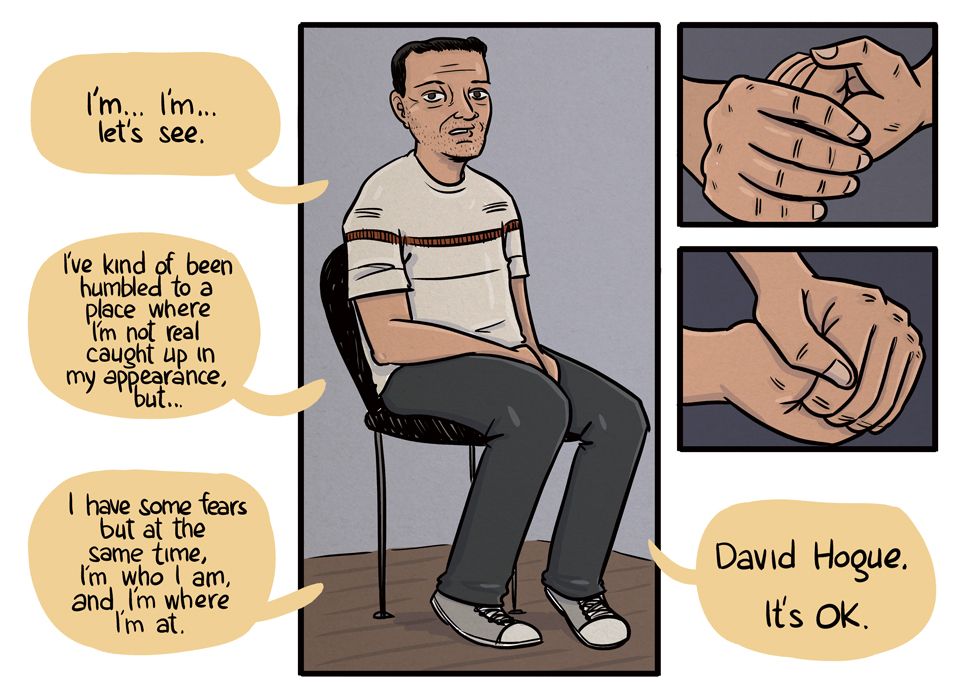
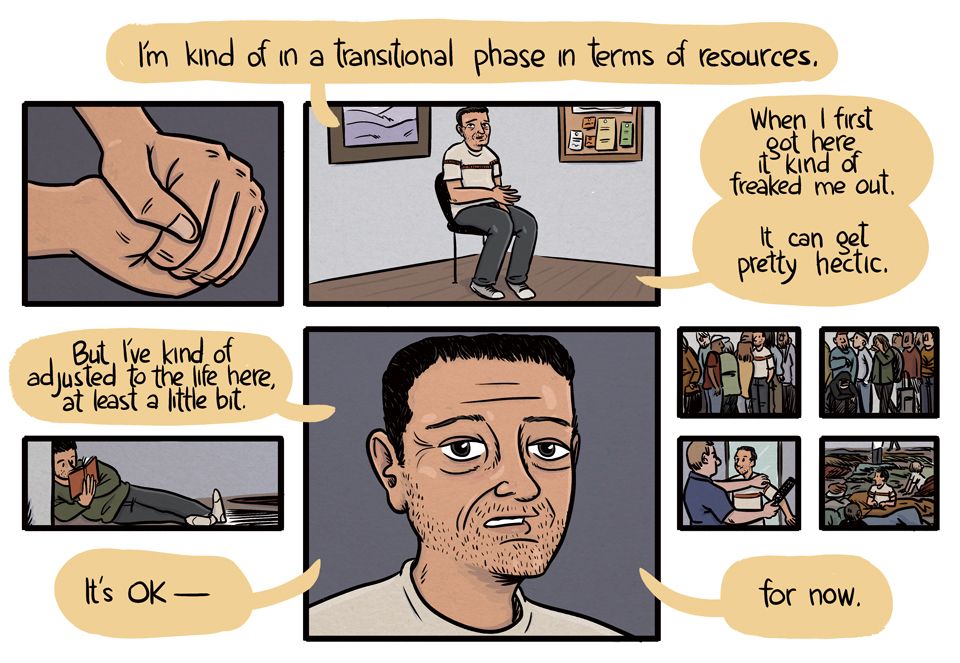
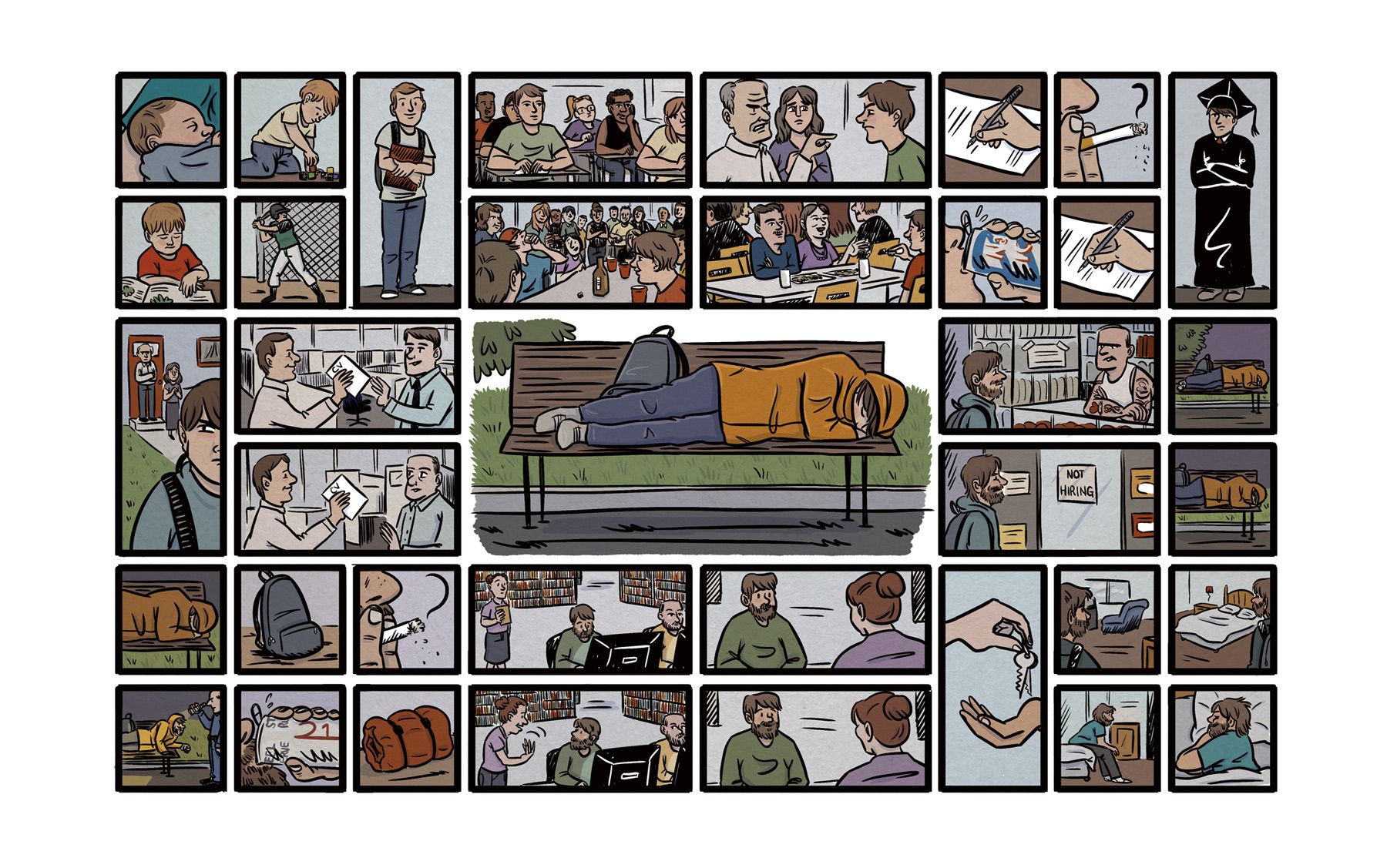
David Hogue isn’t sure that he should tell me his name. He sits in a back office in the shelter where he has lived for the past 18 months, hands folded neatly in his lap. It isn’t that he doesn’t want to talk. He tells me about how he’s had trouble finding work. He tells me about how he’s bounced between homes for years. He tells me about how his brother dropped him off here the day after New Year’s.
But to identify himself as homeless – this is new.
The condition of homelessness is fluid, and so is our definition of it. The United States Department of Housing and Urban Development (HUD) placed the homeless population in January 2014 at 578,424, but advocacy groups such as the National Student Campaign Against Hunger and Homelessness say that more than 3 million Americans experience an episode of homelessness each year: a night, a week or a month in a motel, in a recreation vehicle or on a friend’s couch might not make you ‘homeless’ in the eyes of the federal government, but they certainly define your lived experience.
The US has always had many shades of destitute, but this particular era of homelessness marks a new chapter in the country’s history. The causes of this crisis are no great mystery. Real median household income has plateaued since the 1960s. Adjusted for inflation, minimum wage has fallen since the 1970s. After the manufacturing industry contracted and unemployment grew in the 1980s, the homeless populations in US cities rose precipitously. For the first time since Hooverville – the shanty town built by homeless people during the Great Depression of the 1930s – American poverty was laid bare in its parks and on its streets. Since then, about 600,000 people have lived without a home on any given night in the US.
In every housing market, minimum wage is not enough to afford the average two-bedroom rental. Federal and state programmes to support and serve the mentally ill have been all but entirely dismantled. And the highest prison incarceration rate in the world has only further destabilised poor communities. For the most part, homelessness has been approached as a natural and inevitable plight of contemporary urbanity: a thing to be managed, not fixed.
But now a new optimistic ideology has taken hold in a few US cities – a philosophy that seeks not just to directly address homelessness, but to solve it. During the past quarter-century, the so-called Housing First doctrine has trickled up from social workers to academics and finally to government. And it is working. On the whole, homelessness is finally trending down.
Get Aeon straight to your inbox
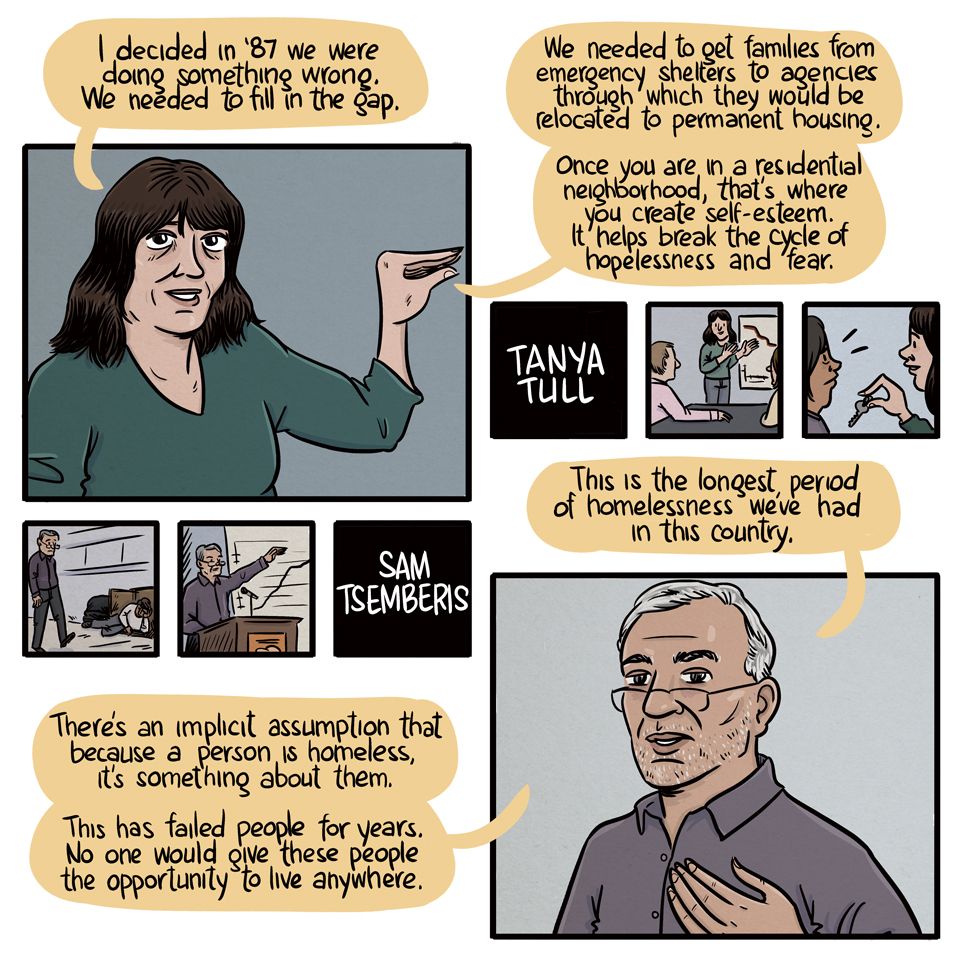
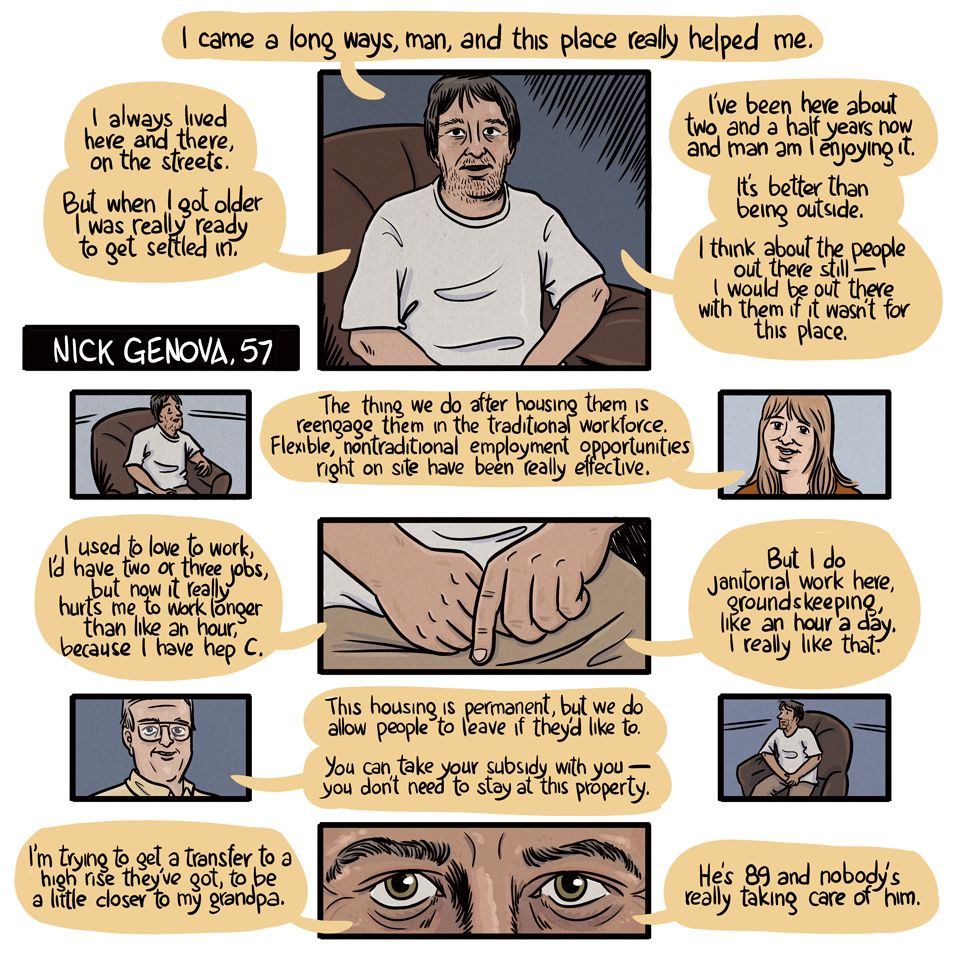
The Housing First philosophy was first piloted in Los Angeles in 1988 by the social worker Tanya Tull, and later tested and codified by the psychiatrist Sam Tsemberis of New York University. It is predicated on a radical and deeply un-American notion that housing is a right. Instead of first demanding that they get jobs and enroll in treatment programmes, or that they live in a shelter before they can apply for their own apartments, government and aid groups simply give the homeless homes.
Homelessness has always been more a crisis of empathy and imagination than one of sheer economics. Governments spend millions each year on shelters, health care and other forms of triage for the homeless, but simply giving people homes turns out to be far cheaper, according to research from the University of Washington in 2009. Preventing a fire always requires less water than extinguishing it once it’s burning.
Related video
Card power of outrospection main
VIDEO
Is the introspection of self-help and therapy hurting our ability to empathise?
10 minutes
By all accounts, Housing First is an unusually good policy. It is economical and achievable. The only real innovation lies in how to inspire the necessary compassion and foresight to spur governments into building those needed homes.
But Housing First is not very popular. It runs directly counter to the US meritocratic mythology, where one is presumed to fail or succeed by one’s own hand. The homeless are presumed to have earned their place on the street.
Precious few places have had the nerve to fully implement a Housing First policy, though hundreds of cities have drawn up the plans. But the approach has been successful in Utah, where chronic homelessness is down 91 per cent over the past decade, and where rapid rehousing programmes have housed thousands of newly homeless veterans and families quickly and cheaply. To the surprise of every self-described progressive, Utah has emerged as a model for municipal programs around the country.
The spread of Housing First could usher in a new kind of compassionate governance in a new era of urban growth – but like any policy, its application is limited. The programs are available only to a small subset of the homeless: those with disabling conditions such as mental illness, alcoholism and drug addiction, whose lives and habits place the biggest financial burden on the state. They are not available to people such as David Hogue, at least not until he becomes more desperate and his plight is deemed too expensive. Even at its most robust, our social safety net is hung very low to the hard ground.
When the federal government embarked on its first significant plan to ‘end homelessness’ more than a decade ago, it seemed less a clear, developed strategy than a kind of dream.
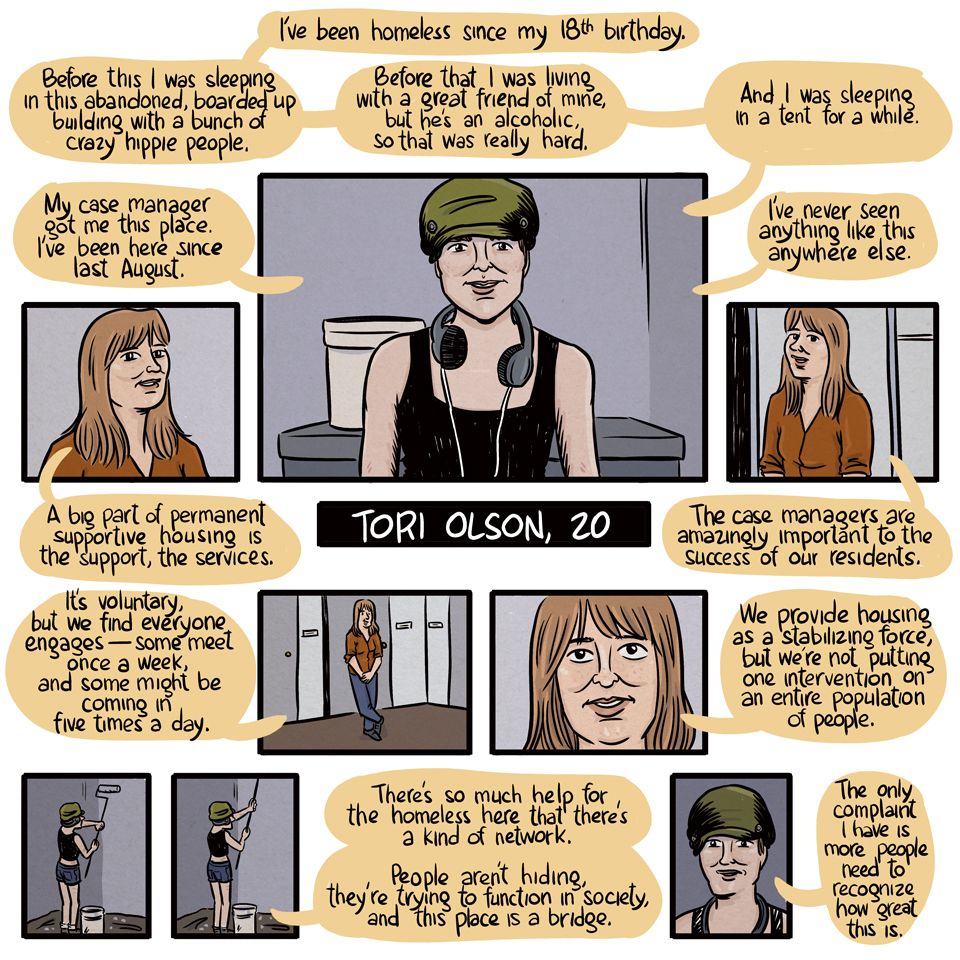
If progressives are surprised by Utah, they will be horrified that Housing First began under President George W Bush. Between 2002 and 2003, hundreds of service providers and local officials met in Washington, DC to learn about the policy. Housing First generally comprises two prongs: permanent supportive housing for the chronically homeless, defined as those prone to long bouts of homelessness as well as substance abuse or mental health issues; and rapid re‑housing assistance for the less acutely homeless, who are typically aided in finding a home rental and given basic living funds for a few months to help stabilise them.
Representatives from cities and states across the US spent the policy camp devising ambitious plans to reshape their communities, but Utah was one of the precious few to actually implement theirs.
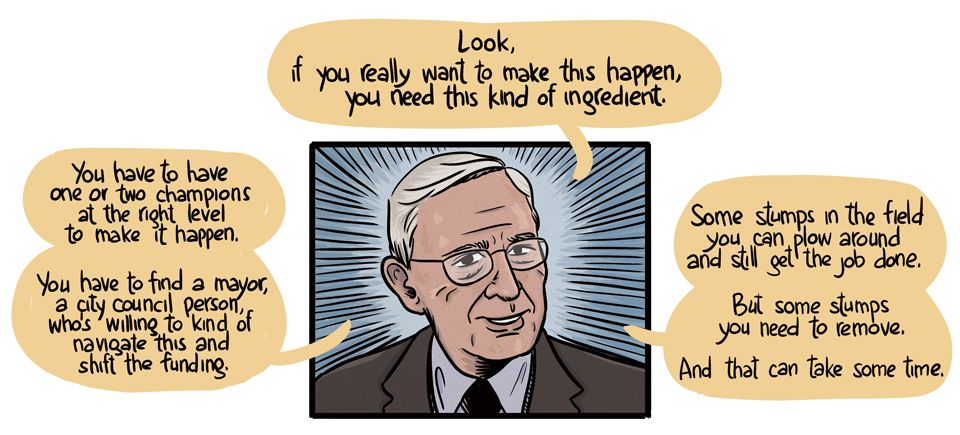
‘People ask, why Utah?’ Lloyd Pendleton, the head of Utah’s Homeless Task Force tells me. Pendleton spent years as an executive at Ford Motors before taking a job managing resources at the Church of Jesus Christ of Latter-Day Saints (LDS) that put him in close contact with service providers and aid groups across the state. After that 2003 meeting, he asked the Church to ‘loan him’ to the government to devise the plan, and later took the position at Utah’s Homeless Task Force. At the time, Utah had a fast-growing homeless population, a strong and homogenous local community, a faith-based ethic of mutual aid, resources, and, in Pendleton, a uniquely empowered champion.

In 2010, President Barack Obama’s administration released its ambitious plan for a reboot of the programme first started under Bush. The Obama plan was released quietly, but it came with a mandate and a timeline: to end chronic and veteran homelessness by 2015, and family and child homelessness by 2020. By then, Utah’s Housing First pilot programme had already proved successful: 17 of Salt Lake City’s most troubled and most expensive homeless people were given their own apartments.
Nowhere else is quite like Salt Lake City, ‘the Crossroads of the West’, first settled by a desperate people with nowhere else to go. The Mormons who established the state in religious exile were close-knit, self-sufficient, and passionate about their personal liberty. This was never a community with much regard for the laws and policies of a hostile federal government, and that spirit has never really changed. On some points, this slice of the Wild West appears conservative: there’s an emphasis on preserving personal freedoms, and no particular love for taxes. But on others, this culture born of a very independent yet interdependent commonwealth is more truly progressive than any ‘blue-collar’ state.
When I visited Utah, people kept telling me that collaboration made this shift possible. For the most part, the only people who care much about the homeless are the people whose job it is to do so. Pendleton made it his mission to change that. With his background in corporations and the Church, he was successful in bringing government, non-profits, faith-based organisations, and business leaders to his table. He was able to persuade them that homelessness required a solution that went far beyond the capacity of traditional social welfare services. This seems obvious but proved radical: no longer could service providers compete with one another for the same funding, and neither could business leaders complain about the visible homeless but claim that they had no say in the solution.
‘When you go to a homeless summit, the only people there are homeless service providers,’ Pendleton tells me. ‘You need that higher community buy-in, a higher level of coordinated effort.’
This daisy chain of partnerships includes the non‑profit organisation Housing Opportunities, which develops and manages dedicated permanent supportive housing facilities across the greater Salt Lake County area.
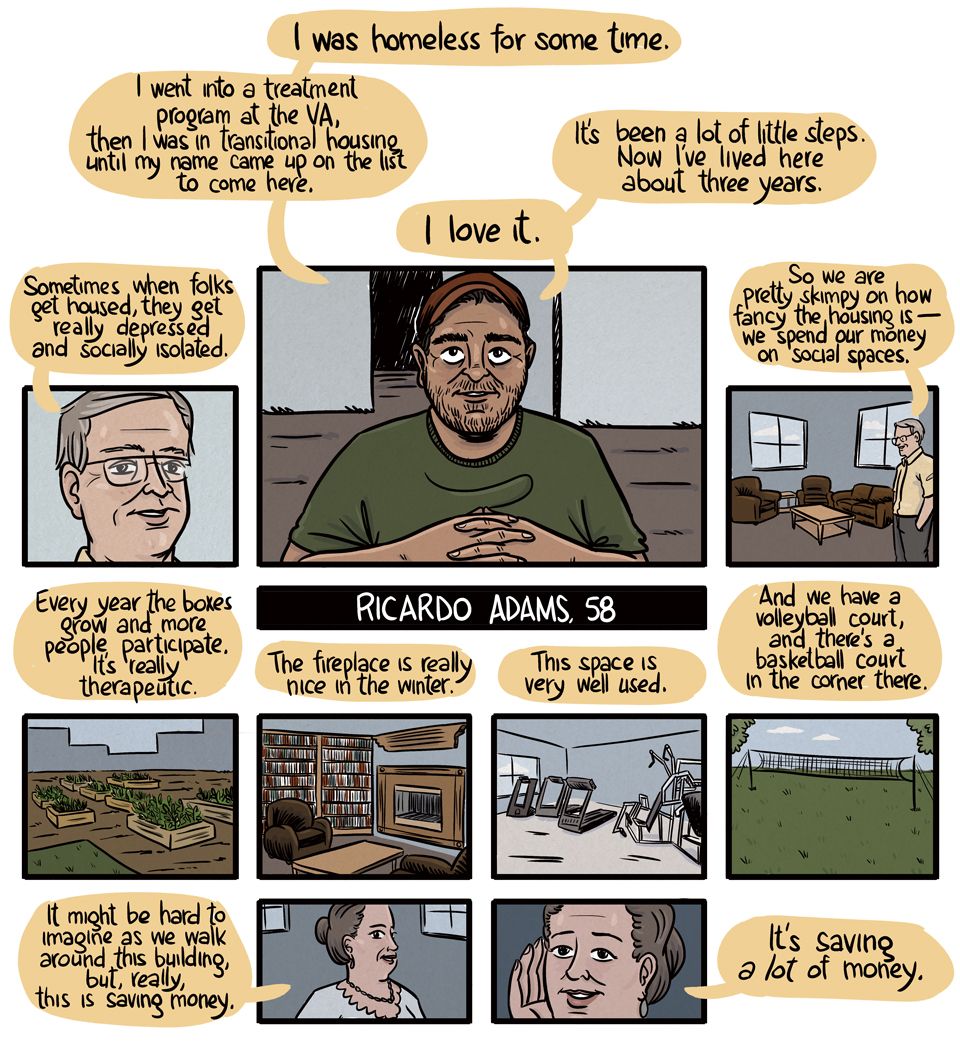
Housing Opportunities’ apartment buildings are located away from the downtown business district and closer to residential areas. They feel more like college dorms than institutions. Communal areas, gyms, computer labs, libraries, community gardens and athletic facilities – it’s safe to brag about the amenities when all of this is cheaper than the alternative.
This kind of permanent supportive housing is developed by both public and private non‑profit entities using established funding streams already dedicated to affordable housing programmes. In Salt Lake County, the Road Home non-profit and the Housing Authority of Salt Lake City also operate similar dedicated facilities for families and individuals. Permanent supportive housing programmes also place the homeless in regular Section 8 housing, under which landlords accept housing vouchers in lieu of payment.
The rent is, at minimum, $25 per month, or one-third of a resident’s income if there is any, which some earn by working janitorial, clerical or landscaping jobs at the facility. The rest of the cost is subsidised by pre-existing HUD funding and special grants.
While it looks like its own separate policy structure, Housing First is truly just a reconsideration of entrenched housing programmes and budgets. Utah is not especially rich compared with other states, and its chronic homeless weren’t so uniquely inexpensive as to leave the state with the surplus it needed to build this new infrastructure. Much of the work of housing support staff is spent searching for a particular grant, voucher or other funding stream that best fits each client.
On my way to Utah this May, I read a letter to the editor in a local Salt Lake newspaper, decrying Housing First as wasteful, hopeless and a general insanity. Advocates in Utah tell me this isn’t a terribly common refrain. But it speaks to entrenched US attitudes that could forestall the wide‑scale adoption of the Housing First approach.
Americans have a deep and abiding faith in the strength of one’s own bootstraps – regardless of whether or not one can afford boots. The prevailing system of subsidised housing in early US history was the workhouse or poor farm, where the otherwise homeless endured hard manual labour in exchange for meagre accommodations. It wasn’t until President Franklin Roosevelt’s sweeping New Deal that the nation’s first public assistance programmes were established in the 1930s, including subsidised housing. But in the decades since, those programmes have, in many ways, come to look more like the old workhouse than progressive social policy.
Aid is almost always predicated on a system of incentives: a Rube Goldberg machine of carrots, sticks and innumerable pulleys to wrench the homeless constantly in new and opposing directions. Assistance is given conditionally and you must earn it, just as you are presumed to have earned your place in hardship. Temporary transitional housing programmes, which are still the dominant form of housing available to the homeless in the US, hinge on righteously rewarding good behaviour – participation in drug treatment programmes, successful performance at a job – and punishing bad behaviour with eviction.
Since the recession of the previous decade, more than 20 US states proposed laws to require all applicants for public assistance to pass a drug test. Those laws were ruled unconstitutional, but at least 13 states have passed legislation requiring some recipients of food stamps, welfare or other public assistance to submit to drug testing, and at least 18 more states have proposed similar laws.
In this cultural environment, it’s best to pitch Housing First not as a holistic ideology that reimagines the true nature of the social safety net and the rights of individuals, but as a strict cost‑saving measure: the carrots are far less expensive than the sticks, at least for those at the extreme ends of homeless life.
If Utah is the ideal model, then Hawaii has become the cautionary tale. Article 9, section 10 of the Hawaii state constitution is a precept in native Hawaiian law, the Law of the Splintered Paddle. It was first established by King Kamehameha in 1797 with the intent of protecting the poor:
Oh people,
Honor thy god;
respect alike [the rights of] people both great and humble;
May everyone, from the old men and women to the children
Be free to go forth and lie in the road (ie by the roadside or pathway)
Without fear of harm.
Break this law, and die.
In the ensuing centuries, the Law of the Splintered Paddle has been reconsidered as a statement on public safety as homelessness has been criminalised. It is easy to live without a home in temperate and traditionally culturally tolerant Hawaii. This has long frustrated the state’s more conservative politicians, who first offered the homeless strange carrots – plane tickets back to their home communities – before resorting, quite literally, to sticks. In late 2013, the state representative Tom Brower took a ‘tough-guy’ approach to the state capital’s homeless problem, by smashing any shopping cart he found with a sledgehammer, after thoughtfully removing the homeless person’s belongings from it first. Recently, Hawaii killed a proposal for a homeless bill of rights, and upheld a law banning people from sitting or lying on public sidewalks.

Bans on sitting or lying in public spaces have also been instituted in California, in such progressive bastions of hippie idealism as San Francisco, Santa Cruz and Berkeley, and nearly one-third of other US cities. Bans on begging, sharing food with homeless people and sleeping in cars make the homeless life nearly impossible in hundreds of other US cities. These policies are predicated on the reality that homelessness is a local problem, and the fantasy that, if driven to the most rural parts of the country, the homeless will simply cease to exist. These laws are good for property values, but not for city budgets – a study by the University of California, Berkeley in 2015 found that they prove expensive to enforce.
Cities these days have less and less room for the homeless, the poor, and even much of the middle class. New demand for urban life has far outstripped the housing capacity of most major cities, and every county in the US is facing an affordable-housing crisis. Where cities were once the easiest place to be poor, with access to services, aid, transit and small housing accommodations, they’ve now become nearly impossible.
Alongside this new economic pressure, a wave of self-described progressive policies has reclaimed urban spaces in the name of sustainability and innovation. Urbanists say that cities are our innovation hubs, our policy labs. Many of the cities with the most passionately stated progressive politics are the ones with the most expensive housing markets and the most desperate homeless communities. These are the places we’ve come to associate with innovation.
The most substantive critiques of Housing First point to this larger economic reality: homelessness is a problematic condition, but it is not the problem in itself. Our economic policies guarantee that there will always be someone left behind, and without addressing this core problem, any triage can’t really stem the bleeding. In the meantime, every policy is, by its nature, a half measure. Unfortunately, there is a growing market for quick fixes masquerading as solutions for systemic problems. ‘Teach the homeless to code’ was a joke before it was a reality in San Francisco, followed soon by the homeless shower bus, and innumerable homelessness-solving apps.
When the tech worker Greg Gopman wrote a Facebook post decrying San Francisco’s homeless and comparing them to wild animals, he was righteously vilified. Gopman atoned for his sins by performing light community service with local homeless groups, and then reimagined himself as a homeless advocate and new solutionist. Gopman’s latest plan to solve homelessness involves building intentional communities made up of tiny geodesic domes furnished only with a bed, for which residents pay $250 per month for a maximum of six months. Residents must be sober and have no history of mental illness.
Gopman calls these ‘transition centres’, a nod to the transitional housing model that cities are rejecting in favour of permanent housing. He’s currently seeking ‘investors’. When I tell service providers in Utah about Gopman, they look at me like they smell something rotten.
Those who cheer Utah’s impressive success have repeatedly called the Housing First programme ‘shockingly simple’. This would be lazy if it weren’t also wrong. In reality, Housing First is incredibly complex, and requires a very specific set of conditions in order to actually work. If cities set out to solve this complicated and expensive social problem before they’ve embraced the underlying philosophy that housing is a human right, they are likely to fail.
Despite its remarkable run in Utah, Housing First has been slow to spread through the rest of the US. Since 2002, cities and states have implemented Housing First ideas with varying degrees of success. Houston and New Orleans achieved their initial goals, but Seattle failed – because, according to the director for the city’s largest non‑profit service provider, it didn’t implement Housing First at the scale the city required.
Pendleton’s successes at Utah’s Homeless Task Force attracted media attention, including an appearance this January on The Daily Show, which made it possible for Pendleton to begin consulting cities on how to do what he did.
‘I’m looking to find an Orlando, a Denver, that’s serious about making this happen,’ Pendleton tells me. ‘My goal personally is to find a half a dozen states or counties or cities, and become a regular participant with them and say here’s how we did it, here are the principles, now let’s find the champions locally.’
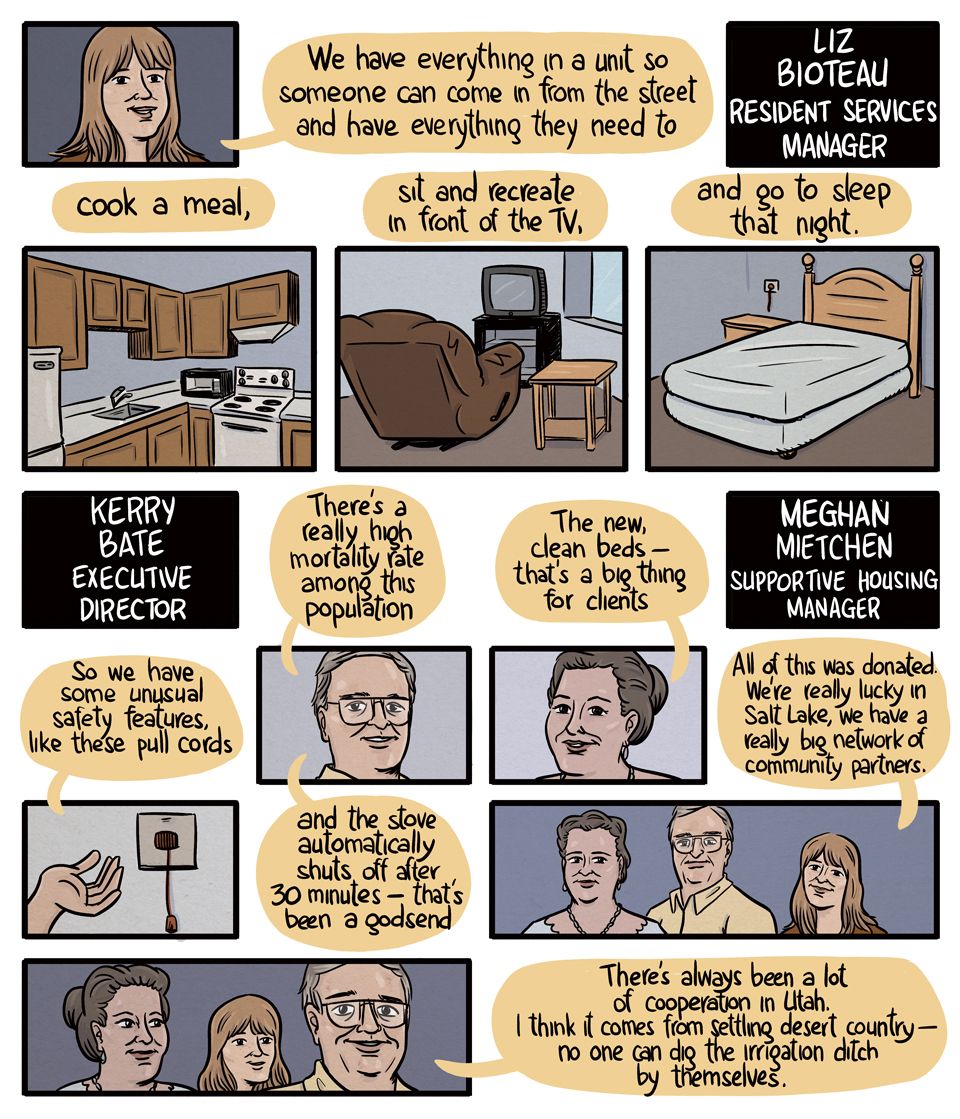
But heroes and ideas alone do not make change. What made Utah’s programmes successful was concentrated power and wealth in the LDS Church – the Church that Pendleton brought to the table. Kerry Bate, the executive director at Housing Opportunities, recounts how they organised congregations to assemble the furniture for all of the apartments – which they’d also donated. It took only a few hours. ‘The Church can go both ways,’ he tells me. ‘It can smother you or you can blossom.’
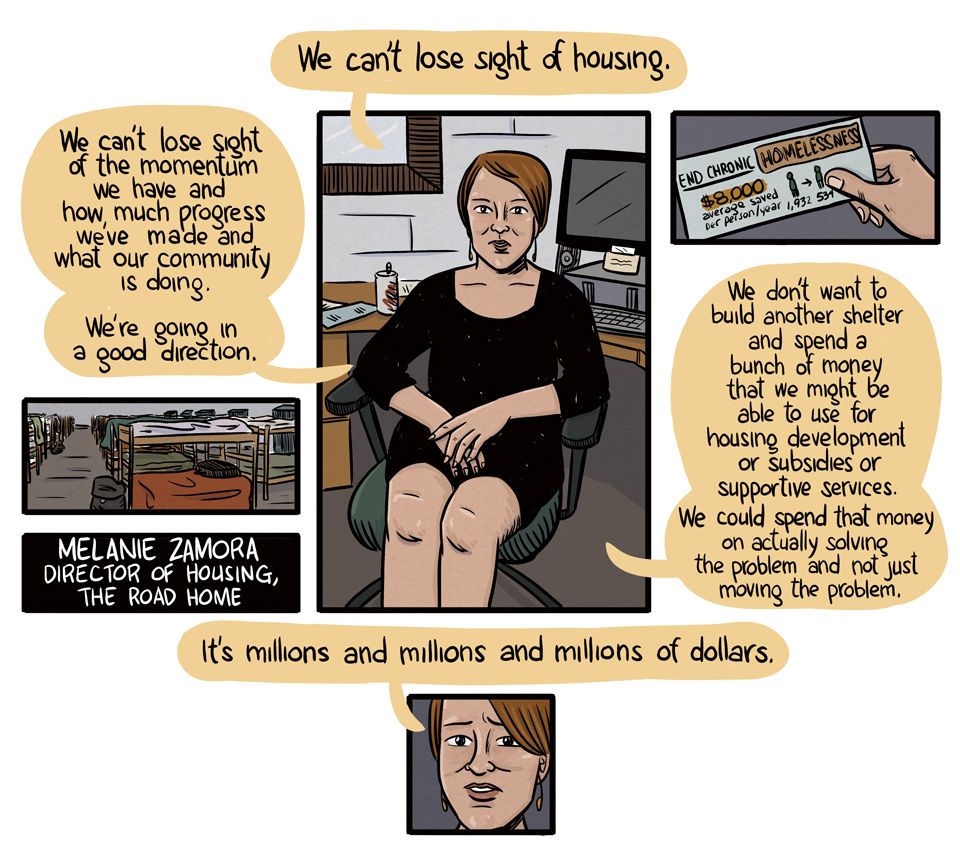
There are, however, still homeless people in Utah. This seems an important point to mention, if a painfully obvious one. The Road Home shelter has never had to turn anyone away, says its housing director Melanie Zamora, but its 850 beds are full each night, and hundreds more homeless sleep in the city parks, under bridges and along the river.
Like many major US cities, Salt Lake is gentrifying, too. It is one of the only places where median wages have outpaced median housing prices, but the city is still short of thousands of necessary affordable-housing units, and homelessness overall has increased precipitously since the recession. Downtown near the Road Home, dozens of the homeless spend their nights inside a shelter, and their days in the nearby streets and parks. Blocks away, renovated condo lofts are selling at a premium, and cranes work morning to night to build more. One developer began a neighbourhood group and campaign to move the shelter to the other side of the freeway, where the real estate is less valuable and accessible. It would be a lucrative move for Salt Lake’s housing market, and a significant blow to housing the homeless.
It is not that Housing First is broken, it’s just that it’s not nearly enough.
For people such as David Hogue, this all amounts to cold comfort, the policy equivalent of the hard mats you have to sleep on if you arrive too late at the shelter to get a real bed.
For Hogue to receive more help, his intolerable condition must become even more intolerable.
‘He’s been here for a year and a half – but he’s not chronically homeless?’ I ask Zamora.
‘If we don’t do something soon, he will be,’ she says.