FAIR USE NOTICE

FAIR USE NOTICE

A BEAR MARKET ECONOMICS BLOG

OCCUPY EVERYTHING

This site may contain copyrighted material the use of which has not always been specifically authorized by the copyright owner. We are making such material available in an effort to advance understanding of environmental, political, human rights, economic, democracy, scientific, and social justice issues, etc. we believe this constitutes a ‘fair use’ of any such copyrighted material as provided for in section 107 of the US Copyright Law.

In accordance with Title 17 U.S.C. Section 107, the material on this site is distributed without profit to those who have expressed a prior interest in receiving the included information for research and educational purposes. For more information go to: http://www.law.cornell.edu/uscode/17/107.shtml

If you wish to use copyrighted material from this site for purposes of your own that go beyond ‘fair use’, you must obtain permission from the copyright owner.

FAIR USE NOTICE FAIR USE NOTICE: This page may contain copyrighted material the use of which has not been specifically authorized by the copyright owner. This website distributes this material without profit to those who have expressed a prior interest in receiving the included information for scientific, research and educational purposes. We believe this constitutes a fair use of any such copyrighted material as provided for in 17 U.S.C § 107.

Read more at: http://www.etupdates.com/fair-use-notice/#.UpzWQRL3l5M | ET. Updates

All Blogs licensed under Creative Commons Attribution 3.0

Creative Commons License
This work is licensed under a Creative Commons Attribution 3.0 Unported License.

Friday, May 6, 2016

Trump is the Least of Our Problems. We Could Have a President Clinton.


Armory of the Revolution


Trump is the Least of Our Problems. We Could Have a President Clinton.

Hillary Clinton Awarded The 2013 Lantos Human Rights Prize

Democrats hoping for a progressive president winning the White House this year will be sorely disappointed unless Bernie Sanders is nominated and elected.
If Hillary is nominated and elected we will not have anything close to a progressive president.
The differences between the progressive Sanders and Hillary Clinton are profound.
Merely donning the cloak of a Democrat in no way means one is a progressive.
Hillary supports a belligerent foreign policy. Bernie does not.
Hillary embraces trade agreements. Bernie does not.
Hillary accepts bribes from Wall Street. Bernie does not.
Hillary opposes universal healthcare. Bernie supports it.
Hillary supports military interventionism. Bernie does not.
Hillary supports regime change. Bernie does not.
Hillary opposes raising the cap on Social Security contributions. Bernie does not.
Hillary opposes banning corporate money from politics. Bernie does not.
Hillary supports the revolving door between industry and government. Bernie opposes it.
Should Bernie be unsuccessful in winning the Democratic nomination, he has said he would support Hillary Clinton. But he has also said that she would have to earn the votes of his supporters.
Here are some of the problems she faces in winning our votes:
Like the general public, Berners do not trust Hillary.
Berners are not persuaded that they must fall in line behind Hillary in order to keep Donald Trump out of the White House.
Most Berners do not like Trump, but he is actually closer to Bernie than is Hillary on trade, military adventurism, corporate control of government, the revolving door, and lobbyists.
If Hillary wins the White House, she will face a divided Congress and gridlock in government, just as Obama has in his second term. In all probability her negatives will continue to grow and she will be perceived as a failed president. As such, it is probable that the Republicans will sweep elections in 2018 and 2020, assuring that Democrats are unable to control reapportionment after the 2020 Census. Just as occurred in 2010, the Republicans will be able to gerrymander congressional districts in 2020, denying Democrats a majority in the House of Representatives until at least 2030.
If Trump is elected president, the exact opposite result occurs, as Democrats will be running against a failed and unpopular President Trump. They would sweep statehouse races in 2018 and win down ballot contests across the country in 2020. After the 2020 Census, Democrats would draw fair and representative districts, and would be assured of a Democratic majority in Congress for a decade.
With Trump as the Republican nominee, the choice between him and Hillary isn’t even close. Trump is the overwhelmingly better choice, on policy issues alone.
When reapportionment is factored in, Trump looks positively attractive.
But the most important consideration is what a Hillary vs Trump outcome would mean for the political revolution we have started.
If Hillary is president, Bernie’s revolution will stall at best, unravel and fail at worst. Hillary and her cohorts at the DNC will do all they can to stop insurgent Democrats from challenging Wall Street Democrats in office. With the power of the presidency at her disposal, Hillary will block Bernie at every turn. Her allies in Congress will make life hell for Bernie Sanders. And for all us progressives hoping to change the system.
If Hillary is defeated, however, Bernie will be the most influential Democrat in the party. The revolution will continue at full speed. No pesky Hillary-bots to interfere with our progress or our agenda.
The establishment is terrified of Donald Trump because they cannot control him, and have no hold over him. That panic is driving the nationwide propaganda campaign against him by politicos, media talking heads, political pundits, and lobbyists.
Hillary is using their propaganda to frighten voters. If she is not elected, that Big Bad Bogeyman Trump will win!
If it comes to her and Trump, I hope he does win.
I will certainly be working for him.


Author’s Notes:
• I am unaware of any other blog with the Armory’s mission of radicalizing the animal movement. I certainly hope I am not alone, and that there are similar sentiments being expressed by comrades unknown to me.
If you know of other blogs dedicated to animal rights and the defeat of capitalism, please comment with a link.
• Be sure to follow the Armory and share it with your Facebook friends and email contacts, as well as on Twitter, Google, and all other social media platforms. Our influence and effectiveness is dependent upon you!
• Natasha Sainsbury, of Good Karma Graphic Design, has joined Armory of the Revolution as Editor, and is responsible for the transformation of the blog’s appearance. Visit and follow her blog V Kind.
• If you are not already subscribed to the Armory, please do so before you leave.
There’s a button to Follow us in the upper right sidebar.
• Be sure to visit Armory of the Revolution’s new commissary and bookstore: The Supply Depot
You will find recommended reading on Animal Rights, revolutionary theory, politics, economics, religion, science, and atheism. There is also a section of supplies for animal liberationists, hunt saboteurs, and social revolutionaries. This is all brand new, and we will be adding lots more merchandise in the near future!
• Feel free to comment. I encourage open discussion and welcome other opinions. I moderate comments because this blog has been attacked by hunters and right wing trolls. I approve comments that are critical as well as those which agree with me. Comments that I will not tolerate are those that are spam, threatening, disrespectful, or which promote animal abuse and cruelty.

Saturday, April 30, 2016

Blurred Line Between Espionage and Truth: Compare and Contrast HRC and Thomas Drake for Having Classified Info.


The New York Times


Blurred Line Between Espionage and Truth


David Carr

Last Wednesday in the White House briefing room, the administration’s press secretary, Jay Carney, opened on a somber note, citing the deaths of Marie Colvin and Anthony Shadid, two reporters who had died “in order to bring truth” while reporting in Syria.


Jake Tapper, the White House correspondent for ABC News, pointed out that the administration had lauded brave reporting in distant lands more than once and then asked, “How does that square with the fact that this administration has been so aggressively trying to stop aggressive journalism in the United States by using the Espionage Act to take whistle-blowers to court?”

He then suggested that the administration seemed to believe that “the truth should come out abroad; it shouldn’t come out here.”

Fair point. The Obama administration, which promised during its transition to power that it would enhance “whistle-blower laws to protect federal workers,” has been more prone than any administration in history in trying to silence and prosecute federal workers.

The Espionage Act, enacted back in 1917 to punish those who gave aid to our enemies, was used three times in all the prior administrations to bring cases against government officials accused of providing classified information to the media. It has been used six times since the current president took office.

Setting aside the case of Pfc. Bradley Manning, an Army intelligence analyst who is accused of stealing thousands of secret documents, the majority of the recent prosecutions seem to have everything to do with administrative secrecy and very little to do with national security.

In case after case, the Espionage Act has been deployed as a kind of ad hoc Official Secrets Act, which is not a law that has ever found traction in America, a place where the people’s right to know is viewed as superseding the government’s right to hide its business.

In the most recent case, John Kiriakou, a former C.I.A. officer who became a Democratic staff member on the Senate Foreign Relations Committee, was charged under the Espionage Act with leaking information to journalists about other C.I.A. officers, some of whom were involved in the agency’s interrogation program, which included waterboarding.

For those of you keeping score, none of the individuals who engaged in or authorized the waterboarding of terror suspects have been prosecuted, but Mr. Kiriakou is in federal cross hairs, accused of talking to journalists and news organizations, including The New York Times.

Mr. Tapper said that he had not planned on raising the issue, but hearing Mr. Carney echo the praise for reporters who dug deep to bring out the truth elsewhere got his attention.

“I have been following all of these case, and it’s not like they are instances of government employees leaking the location of secret nuclear sites,” Mr. Tapper said. “These are classic whistle-blower cases that dealt with questionable behavior by government officials or its agents acting in the name of protecting America.”

Mr. Carney said in the briefing that he felt it was appropriate “to honor and praise the bravery” of Ms. Colvin and Mr. Shadid, but he did not really engage Mr. Tapper’s broader question, saying he could not go into information about specific cases. He did not respond to an e-mail message seeking comment.

In one of the more remarkable examples of the administration’s aggressive approach, Thomas A. Drake, a former employee of the National Security Agency, was prosecuted under the Espionage Act last year and faced a possible 35 years in prison

Thomas Drake

His crime? When his agency was about to spend hundreds of millions of dollars on a software program bought from the private sector intended to monitor digital data, he spoke with a reporter at The Baltimore Sun. He suggested an internally developed program that cost significantly less would be more effective and not violate privacy in the way the product from the vendor would. (He turned out to be right, by the way.)

He was charged with 10 felony counts that accused him of lying to investigators and obstructing justice. Last summer, the case against him collapsed, and he pleaded guilty to a single misdemeanor, of misuse of a government computer.

Jesselyn Radack, the director for national security and human rights at the Government Accountability Project, was one of the lawyers who represented him.

“The Obama administration has been quite hypocritical about its promises of openness, transparency and accountability,” she said. “All presidents hate leaks, but pursuing whistle-blowers as spies is heavy-handed and beyond the scope of the law.”

Mark Corallo, who served under Attorney General John D. Ashcroft during the Bush administration, told Adam Liptak of The New York Times this month that he was “sort of shocked” by the number of leak prosecutions under President Obama. “We would have gotten hammered for it,” he said.

As Mr. Liptak pointed out, it has become easier to ferret out leakers in a digital age, but just because it can be done doesn’t mean it should be.

These kinds of prosecutions can have ripples well beyond the immediate proceedings. Two reporters in Washington who work on national security issues said that the rulings had created a chilly environment between journalists and people who work at the various government agencies.

During a point in history when our government has been accused of sending prisoners to secret locations where they were said to have been tortured and the C.I.A. is conducting remote-controlled wars in far-flung places, it’s not a good time to treat the people who aid in the publication of critical information as spies.

And it’s worth pointing out that the administration’s emphasis on secrecy comes and goes depending on the news. Reporters were immediately and endlessly briefed on the “secret” operation that successfully found and killed Osama bin Laden. And the drone program in Pakistan and Afghanistan comes to light in a very organized and systematic way every time there is a successful mission.

There is plenty of authorized leaking going on, but this particular boat leaks from the top. Leaks from the decks below, especially ones that might embarrass the administration, have been dealt with very differently.

The Clintons, Not Bernie Sanders, Hijacked the Democratic Party

Medium


The Clintons, Not Bernie Sanders, Hijacked the Democratic Party

The heir is not Obama’s, it’s Roosevelt’s


In the 1972 Democratic Primary, Rolling Stone backed young voters who flocked to the grassroots-based campaign of Senator George McGovern who opposed the Vietnam War. Unfortunately, McGovern lost in a landslide and President Nixon was re-elected.

Jann Wenner of the same Rolling Stone decides that we should look at that as a reason to ignore today’s youth who overwhelmingly, 80-85% overwhelmingly, support Sen. Bernie Sanders over Former First Lady, Senator, and Secretary of State Hillary Clinton. He cites young voters’ cravings for “idealism, integrity, and authenticity” as the reason we flock to him, as though that craving in itself is a bad thing. (The fact that there’s video of him predicting almost every policy disaster years before it happened certainly doesn’t hurt, either.)
This is just one piece of a larger argument that Bernie Sanders is hijacking the Democratic Party. Wenner also couples the argument with what he found to be another “very clear lesson: America chooses its presidents from the middle, not from the ideological wings.” Rep. John Delaney of Maryland also argues that we ought to unite at the political center. “I am worried about where some of the loudest voices in the room could take the Democratic Party,” he says, forgetting where the political center is and that Bernie Sanders, in fact, represents the core of what the Democratic Party is — was.
Let us begin with Wenner’s active decision to ignore all evidence showing Bernie Sanders to be more electable, and wants us to instead support Hillary Clinton because George W. Bush, he argues, was so bad for America. Well then, let’s look at his assessment of the Bush Administration’s failings:
Bush brought us into a war that still plagues us today; he authorized massive tax cuts for the rich and the corporations; abandoned the Middle East peace process; ushered in the worst financial crisis since the Depression; and totally neglected the climate emergency.
First, Hillary Clinton supported that war. In fact, just in 2011 she said, “It’s time for the United States to start thinking of Iraq as a business opportunity.” Neoliberal meet Neoconservative. Bill Clinton did little to change tax rates overall and finished the deregulation of banks started by Reagan. Instead of prosecuting banks for gambling with people’s savings, illegal at the time, he repealed the law, Glass-Steagall, and deregulated the rest of the financial market. Hillary Clinton to this day does not support reinstating Glass-Steagall. Wenner brings us back to the Middle East: Based on her speech at AIPAC, is Hillary Clinton in any position to be a neutral supporter of both Israeli and Palestinian interests? (For the record, W. called on Israel to end its occupation of Palestinian land in 2008. Also, for the record, this is not the writer taking a stance for or against Israel or Palestine.) Okay, back to the Economy: worst financial crisis since the Great Depression — yes. Ushered in by President Bush — no. Not completely, at least. That was ushered in by Clintonomics, aka finishing what Reaganomics started.


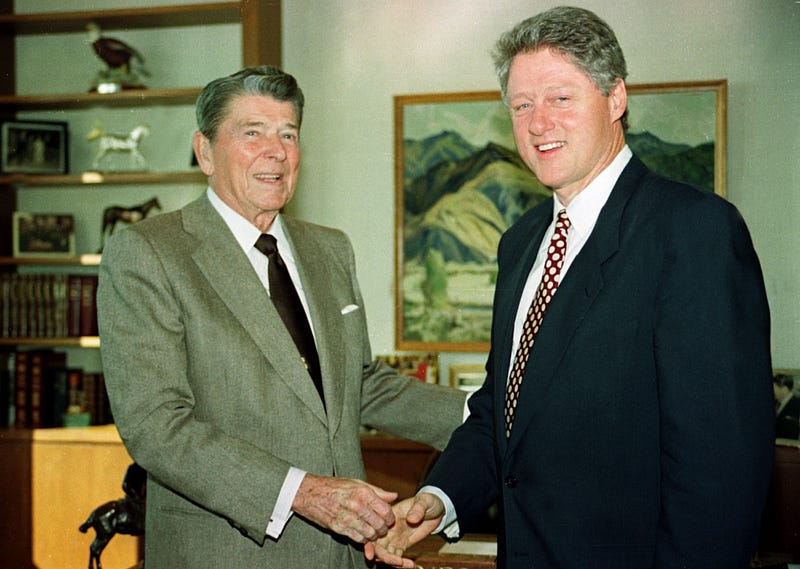
President Reagan with President Clinton

Finally, the crisis that is our climate: Bernie Sanders has an undeniably more aggressive plan to tackle climate change. We don’t have time to debate the extent to which Hillary Clinton’s opinions change based on her donations, which she indeed takes from fossil fuel and oil. The fact is that, regardless, she does not have a strong enough plan to stop and reverse the damage we have done over the years. There is no safe fracking! Support for, or even lack of opposition to, oil pipelines will not cut it for those of us who realize this pressing emergency. (I argue that Bernie’s plan may not even be strong enough — Jill Stein’s Green New Deal would be a crucial start. Bernie, please read this and make Dr. Stein your Labor Secretary! Martin O’Malley for EPA Administrator!)
And cut the crap about donations coming from oil and gas industry employees. For one, that’s still telling. And two, we all know damn well that if the money is not going directly to her campaign, then it’s going to her Super PACs or to the Democratic National Committee’s Hillary Victory Fund, and the same person can funnel their cash through every single state DNC to that same Victory Fund. Double everything if the donor has a spouse who can pledge money in their name. She is sure as hell seeing the benefits of that money, whether you admit it to yourself or not.
So, why such laissez-faire economics in the left wing party? We’ll have to briefly get into history to see where things went wrong. Just as conservatives, for some reason, worship Ronald Reagan, liberals have our own love affair with Franklin Delano Roosevelt. He appointed the country’s first woman Secretary of Labor, Frances Perkins, and together they pulled us out of the Great Depression. The democratic socialist was so popular that Americans elected him four times, keeping Secretary Perkins in his cabinet throughout his tenure from 1933–1945. Their legacy includes Social Security, unemployment insurance, minimum wage, child labor laws, welfare, the whole New Deal. Lots of big government spending and a robust social safety net, oh my! There were Democrats before FDR, many of them good, and a few after, but he receives the due credit of successfully getting the economy up and running after the stock market crash.

After FDR died, in office, his third Vice President Harry Truman succeeded him, followed by Republican war hero Dwight D. Eisenhower. (Keep in mind the 91% top tax rate during this Republican’s administration.) Democrat John F. Kennedy was then elected, succeeded by Vice President Lyndon B. Johnson. Then we had Republican Richard Nixon, succeeded by his Vice President Gerald Ford after impeachment. After that came Jimmy Carter, and then two terms of Ronald Reagan, followed by a term of George H. W. Bush. The lone Democrat Jimmy Carter had one term in the middle of four Republicans. Democrats were not winning presidential elections. Back up a little to find some internal restructuring of the Democratic nomination process, in particular decreasing the influence of party insiders. The first candidate to win this more democratically-held primary was anti-war, grassroots-based George McGovern. Shortly after his 1972 landslide loss to Nixon, Superdelegates were introduced. Twelve Republican-controlled years after Carter had Democrats eager to win back the White House. Rolling Stone’s Matt Taibbi explains how they did it:
That ’72 loss hovered like a raincloud over the Democrats until Bill Clinton came along. He took the White House using a formula engineered by a think tank, the Democratic Leadership Council, that was created in response to losses by McGovern and Walter Mondale.
The new strategy was a party that was socially liberal but fiscally conservative. It counterattacked Richard Nixon’s Southern Strategy, a racially themed appeal to disaffected whites Nixon tabbed the “Silent Majority,” by subtly taking positions against the Democrats’ own left flank.
In 1992 and in 1996, Clinton recaptured some of Nixon’s territory through a mix of populist positions (like a middle-class tax cut) and the “triangulating” technique of pushing back against the Democrats’ own liberal legacy on issues like welfare, crime and trade.
And that was the point. No more McGoverns. The chief moral argument of the Clinton revolution was not about striving for an end to the war or poverty or racism or inequality, but keeping the far worse Republicans out of power.
The definition of Lesser Evil politics. During Clinton’s presidency, Taibbi says, “purity” came to be derogatory, pointing to Richard Rothstein’s 1995 piece in The American Prospect:
In the relative complacency of 1993–94, Clinton’s progressive reforms could have prevailed only with enthusiastic majority support. When liberals indulge themselves with denunciations of Clinton’s compromises, centrists will not fill the void to support a liberal agenda. The balance scale conceit is particularly dangerous because it rationalizes political irresponsibility, justifying liberal opposition with hopes that, by grace of an invisible hand, purism contributes to progressive victory. The conceit excuses unwillingness to share the burden of morally ambiguous compromise, of deciding which promises must be violated or which treasured goals must be sacrificed when confronted with opposing political force. These unpleasant decisions become the president’s alone to make, while liberal confederates flatter themselves that their hands are clean and that their refusal to share responsibility helps move the administration in a progressive direction.
Morally ambiguous compromise — sound familiar?
Bill Clinton vowed not to be weaker than Republicans, so he attacked welfare, gutted our social safety net. He continued deregulating the financial industry like a firstborn heir to the Republicans before him. He introduced trade policies so corporations could manufacture their items in countries without minimum wage laws and import them back to cut costs, as well costing Americans jobs. Clinton unleashed his “tough on crime” platform, which we rightly point to not as the root cause of mass incarceration but for exacerbating what had been done by Republicans. They did all the ground work, they loaded the gun; all Clinton had to do was pull the trigger. And pull the trigger, he did.


Of course Hillary Clinton is not her husband, but if she wants to reminisce about the short-term economic boon of his administration, she cannot reject the failures that come with it. Indeed, she supported all of his policies at the time and most of them today. As Secretary of State she personally oversaw the writing and implementation of more trade deals! And people have the gall to feel offended when we suggest Hillary Clinton is a Republican? Given her history, political tactics, and platform, we might as well have the real thing.


Thanks to Free Trade, corporations can manufacture in countries with no minimum wage and import it back for free

Oh, and where does economist Robert Reich, Bill Clinton’s Labor Secretary, fit into all of this? He has come out in support of Bernie.
So where do we go from here? Can we bring the Democratic Party back to its roots, wave good riddance to the Clintons’ Neoliberalism or is it too far gone? Some argue there is hope, for there is finally mainstream support for the progressive ideals championed by Elizabeth Warren, Martin O’Malley, and Bernie Sanders. There are rising young Democrats like Kyrsten Sinema,Brian Sims, and Kamala Harris . Others say it is soiled by corruption, going as far as calling themselves “Berniecrats” and advocating a new Progressive Party. Given that the Green Party has the social democratic ideals we seek with protections against big money and corruption built into its platform, I suspect misguided resentment lingers against the Green Party for Ralph Nader’s 2000 presidential bid. It’s worth noting that Green candidate Jill Stein’s plan to revitalize the economy and combat the changing climate is based off of FDR’s New Deal. Young voters feel no allegiance to party labels, especially one that has been trying to undermine the one honest candidate since the beginning. One thing is certain: we must oust the residual Neoliberals and Corporatists like Debbie Wasserman Schultz and learn not to repeat our mistakes. The 73-year old grandpa is the future, and past, of the American left.