FAIR USE NOTICE

FAIR USE NOTICE

A BEAR MARKET ECONOMICS BLOG

OCCUPY EVERYTHING

This site may contain copyrighted material the use of which has not always been specifically authorized by the copyright owner. We are making such material available in an effort to advance understanding of environmental, political, human rights, economic, democracy, scientific, and social justice issues, etc. we believe this constitutes a ‘fair use’ of any such copyrighted material as provided for in section 107 of the US Copyright Law.

In accordance with Title 17 U.S.C. Section 107, the material on this site is distributed without profit to those who have expressed a prior interest in receiving the included information for research and educational purposes. For more information go to: http://www.law.cornell.edu/uscode/17/107.shtml

If you wish to use copyrighted material from this site for purposes of your own that go beyond ‘fair use’, you must obtain permission from the copyright owner.

FAIR USE NOTICE FAIR USE NOTICE: This page may contain copyrighted material the use of which has not been specifically authorized by the copyright owner. This website distributes this material without profit to those who have expressed a prior interest in receiving the included information for scientific, research and educational purposes. We believe this constitutes a fair use of any such copyrighted material as provided for in 17 U.S.C § 107.

Read more at: http://www.etupdates.com/fair-use-notice/#.UpzWQRL3l5M | ET. Updates
FAIR USE NOTICE FAIR USE NOTICE: This page may contain copyrighted material the use of which has not been specifically authorized by the copyright owner. This website distributes this material without profit to those who have expressed a prior interest in receiving the included information for scientific, research and educational purposes. We believe this constitutes a fair use of any such copyrighted material as provided for in 17 U.S.C § 107.

Read more at: http://www.etupdates.com/fair-use-notice/#.UpzWQRL3l5M | ET. Updates

All Blogs licensed under Creative Commons Attribution 3.0

Creative Commons License
This work is licensed under a Creative Commons Attribution 3.0 Unported License.

Saturday, October 3, 2015

Study: 90% of Criminal Corporations Are Republican


buzzflash-header


Study: 90% of Criminal Corporations Are Republican


ERIC ZUESSE FOR BUZZFLASH AT TRUTHOUT
Ninety percent of the corporations that were criminally convicted between 1989 and 2000 donated overwhelmingly to the Republican Party in 2012.
study by the Corporate Crime Reporter, Russell Mokhiber, found that, “Ten out of the current top 100 donors to the 2012 political campaign have plead guilty to crimes.” The criminal-convictions file that was considered in his study included convictions during the ten years between 1989 and 2000.
An examination of this list, by the present reporter, indicates that nine of these ten big-donating criminal firms gave far more to Republican political campaigns than to Democratic ones. Only one firm, Pfizer, donated more to Democrats; and they contributed only slightly more to Democrats than to Republicans. By contrast, each one of the nine big-donating Republican criminal corporations – Honeywell, Lockheed, Blue Cross Blue Shield, Boeing, GE, Northrop, Koch Industries, Raytheon, and Exxon – donated far more to Republicans than to Democrats; and the most lopsidedly political criminal firm of them all, Koch Industries (which organized the “Tea Party” starting when Obama first entered the White House), donated a whopping 98% to Republicans.
At least according to this measure, criminal firms prefer Republican politicians overwhelmingly. It is rare, almost unheard of, to find a population that is so lopsidedly favorable to one Party over the other, as this one is: 90% vs. 10%.
Mokhiber provided the donation-figures, for each of these ten convicted firms, based on federal filings.
Another and related Mokhiber study, which was published on 3 April 2012, was titled “No Fault Corporate Crime,”and he quoted there the first-ever statement that Attorney General Eric Holder had made as the U.S. Attorney General that had employed the phrase “corporate crime.” In this statement, Holder expressed himself as being against prosecuting corporate crime, because he felt that only individuals should be criminally prosecuted. Holder has, however, also opposed criminal prosecutions of top corporate executives as individuals: not a one of them has been even prosecuted, during his term, much less convicted. Mokhiber pointed out that Holder came to his federal office from the elite corporate law firm of Covington & Burling, which defends corporations against criminal prosecutions. Mokhiber also noted, “And he’s going back to Covington & Burling.” So: Holder’s future income will be derived from corporations that will be hiring C&B to defend them from prosecutions for crimes, and from other legal charges against them. In other words: President Obama, when he had hired Holder, was actually hiring a career defender of corporations; and this person, Holder, has been continuing in this very same capacity while on the federal payroll, during his four-year hiatus from his career, as a professional corporate defender. Holder is, in other words, doing what is in his long-term personal career interest: protecting big-corporate criminals.
As the U.S. Attorney General, Holder’s policy regarding corporate criminality has been to seek what is called “deferred prosecution agreements” (basically agreements not to prosecute) instead of outright criminal convictions, against criminal firms. This policy has been carried out by Lanny A. Breuer (also from C&B), Obama’s appointed head of the Justice Department’s Criminal Division. Breuer’s chief argument for “deferred” (or actually non-) prosecutions, has been that after the accounting firm Arthur Anderson & Co. was almost put out of business by being criminally convicted in the 2001 Enron case, the Obama-Holder-Breuer team don’t want to hurt another criminal corporation, in a similar way.
However, a study that will be published in the Spring 2013 University of Pennsylvania Journal of Business Law  will headline “Arthur Anderson and the Myth of the Corporate Death Penalty: Corporate Criminal Convictions in the Twenty-First Century.” Its researcher, Gabriel Markoff, says there: “No one has ever empirically studied what happens to companies after conviction. In this article, I do just that.” He summarizes his core finding: “The Department of Justice’s policy of preferring DPAs [deferred prosecution agreements, as opposed to criminal prosecutions] is insupportable.” In other words: Markoff finds that Obama has, essentially, been hiding behind a bogus argument, in order to protect executive crooks from being prosecuted.
Furthermore, Obama’s selected Treasury Secretary, Timothy Geithner, has similarly refused to support criminal prosecutions of the mega-bank executives who had created the incentive-systems that produced the enormous fraudulent MBS(mortgage-backed-securities)-marketing bonuses for themselves, and that crashed the U.S. economy in 2008. Geithner, like the other key Obama appointees, comes from a background in which he has served, virtually all his life, the aristocracy that runs the Wall Street firms, and that invests in them; and those executives and investors were bailed out of their “toxic assets” by the U.S. Treasury, and by the Federal Reserve (i.e., by future U.S. taxpayers). Geithner, as the President of the New York Federal Reserve, had served the Wall Street banks back then, even prior to his being selected by Obama as Treasury Secretary.
As a consequence, corporate criminal prosecutions have been even fewer under President Obama than they were under the overtly Republican President, George W. Bush – and those convictions were already at historic lows.
So, if criminal corporations are still donating overwhelmingly to the Republican Party, one might wonder what can possibly be the reason, given that those executives have been getting such a terrific deal from Obama, who (at least nominally) is a Democrat? Perhaps they think that Republican politicians give them an even better deal. For example, Wall Street donated overwhelmingly to the Republican Romney campaign, against Obama, and Romney was (even publicly) promising them the moon.
When Obama, on 27 March 2009, in a private White House meeting with Wall Street CEOs, had told them “My administration ... is the only thing between you and the pitchforks,” and he thus analogized those crooked billionaires to the poor Blacks who had been hunted down and lynched by the KKK in the deep South a hundred years earlier, this seems not to have persuaded them, even though Obama actually did follow through on this secret promise he made to those financial elite that day. And Obama-Geithner-Holder-Bernanke and team did also follow through, and they completed George W. Bush’s bailout of them, and of their top crony investors.
Perhaps what Mokhiber’s study, and others, are indicating, then, is that America’s public is simply spoiling its financial elite, who feel that there is no limit to the privileges that they deserve. Staying out of prison, and even being bailed out by future U.S. taxpayers, isn’t already enough to satisfy them. They want the moon, which Romney promised them. And they almost got it. In the popular vote, at least, Romney lost by only a 2.5% margin. There were evidently lots of Americans who wanted to give the moon to these elite executives.

Saturday, September 26, 2015

American Politics: The Dilution of the Left and Psychosis of the Right


THE PROGRESSIVE CYNIC

MODERN AMERICAN POLITICS IS FILLED WITH PARTISANSHIP, LEGALIZED CORRUPTION AND EXTREMISM. ON THIS SITE YOU WILL FIND ARTICLES ON A VARIETY OF SUBJECTS AND POINTS OF VIEW THAT ARE NOT NORMALLY PORTRAYED IN THE CORPORATE MEDIA–DON’T EXPECT ANY SUGAR-COATING, PANDERING OR INTEREST MONEY PROPAGANDA HERE.


American Politics: The Dilution of the Left and Psychosis of the Right


© Josh Sager – February 2014
 Politics_01c
In recent years, the American political landscape has become paralyzed by a toxic combination of partisan extremism, legalized corruption by moneyed interests, and an obstinately “neutral” media that calls every argument even. Unfortunately, this political climate has bred a situation where one political party has become diluted in its policy preferences while the other is growing increasingly irrational and unstable.
The national Republican Party has attempted to purify itself of almost every representative who does not share in an extreme right wing ideology—even longstanding conservatives like Mitch McConnell are facing ouster from even more extreme right wing candidates. Outside money from partisan interests (ex. the Koch brothers and Walton family) has driven this process, and now these highly extreme politicians have gained enough power to manipulate the GOP in its entirety.
Today, the party line of the GOP is so extreme that it rejects reality and prefers to live in an alternate universe—in this world, climate change isn’t a problem, all regulation is communism, taxes are always too high, the market will work best for all Americans if it is left to its own devices.
The GOP’s partisan purification displaces moderates from the party and forces some to find refuge with the Democrats. While this distillation party shrinks its ranks in the electorate, partisan gerrymandering and the high levels of motivation among their extreme constituents have allowed the GOP to retain enough representation to obstruct the legislative process.
fivethirtyeight1-blog480
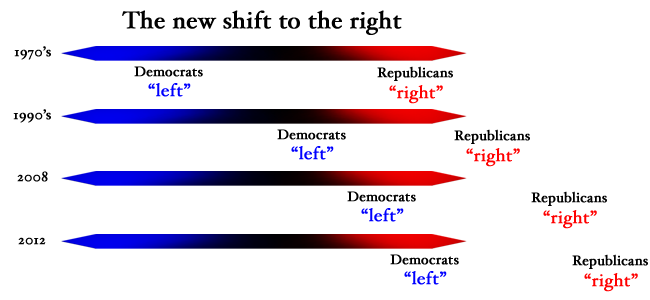
At the same time that the Republicans are fighting their internal partisan war of purification, the Democrats—who are theoretically our country’s left wing party—have become diluted to the point where their policy proposals are center-right. Here are a few examples of this shift:
  • The Democrats support cap and trade, which is the center-right, market-based proposal that the GOP once supported.
  • The Democrats passed ObamaCare, which is the center-right health insurance solution thatthe GOP championed as the alternative to single-payer or nationalized healthcare.
Beginning with pro-corporate Democrats like Bill Clinton and the blue dogs making common ground with the right wing, the Democrats have steadily moved to the right. What was once the Republican position is now the Democratic Party platform and what was once the Democratic Party platform is considered extreme-left (or socialist by the GOP). When combined with the need to compromise with the extreme-right GOP, this rightward shift for the Democratic position has resulted in the implementation of solidly right wing policies.
The dilution of the Democratic Party ideology with centrists and GOP refugees has eliminated the power of the left within the party. Currently, the American left is largely adrift and without substantive representation in office—it is certainly true that members of the House Progressive caucus and senators like Elizabeth Warren are representing a truly-leftist agenda, but they are hardly in control of their party.
In effect, the entire political spectrum has been shifted to the right and the American people have been left in the dust. Just because the acceptable views of Washington partisans changes, it doesn’t mean that the opinions of those who they theoretically represent do. Large portions of the American population are now being forced to choose between voting for a Democratic Party which doesn’t support their ideals and a Republican Party which has suffered a collective psychotic break.
1383165237_zps8a6c22ff
Unfortunately, the media has largely ignored its duty to report the facts objectively and has neglected to point out these shifts in the partisan landscape. The media portrays the Democrats as representing the left and the Republicans as representing the right, while, in reality, the actual policy consequences of negotiations between the parties shifts underneath the surface.

Friday, September 18, 2015

For The Record, Yes, George W. Bush Did Help Create ISIS


Politifact


Mostly False
Bush
"ISIS didn't exist when my brother was president. Al-Qaida in Iraq was wiped out when my brother was president."
— Jeb Bush on Wednesday, May 20th, 2015 in a roundtable in New Hampshire


Jeb Bush: 'ISIS didn't exist when my brother was president' and al-Qaida was 'wiped out'

Former Florida Gov. Jeb Bush speaks at a roundtable in New Hampshire May 20, 2015.
After former Florida Gov. Jeb Bush faced a tough couple of weeks related to his comments about whether he would have invaded Iraq even if he had known about faulty intelligence, he used a new tactic in New Hampshire: Blame President Barack Obama.
"The world is radically different, and so the focus ought to be on ‘knowing what you know now, Mr. President, would you, should you have kept 10,000 troops in Iraq?’ " Bush said at a roundtable event in Portsmouth May 20.
Bush noted that the Iraqi city of Ramadi had been taken over by ISIS the day before his roundtable. He then continued:
"ISIS didn’t exist when my brother was president. Al-Qaida in Iraq was wiped out when my brother was president. There were mistakes made in Iraq for sure, but the surge created a fragile but stable Iraq that the president could have built on....." He then criticized how Obama has handled Iraq.
We decided to fact-check Bush’s claims that ISIS did not exist under President George W. Bush and that al-Qaida was wiped out in Iraq. (The Washington Post’s The Fact-Checker examined this issue as well.)
‘ISIS didn't exist when my brother was president’
A spokesman for Bush’s political action committee pointed to a 2014 op-ed by Ali Khedery, who served as senior adviser to three heads of US Central Command from 2003-10.
It starts by saying, "Three years ago, the Islamic State (ISIS) did not exist; now it controls vast swaths of Syria and Iraq."
Technically, yes, a group with the name "ISIS" did not exist under President Bush.
The group’s roots, however, trace back to 2004.
"There were evolutions that took place with some of the name changes," said Daveed Gartenstein-Ross, senior fellow at the Foundation for Defense of Democracies.
In 2004, long-time Sunni extremist Abu Mus‘ab al-Zarqawi established Al-Qa‘ida in Iraq (AQI), also known as the Islamic State of Iraq (ISI) and more recently the Islamic State of Iraq and the Levant (ISIL), according to the National Counterterrorism Center.
After he was killed in a U.S. airstrike in 2006, the group was renamed the Islamic State of Iraq.
In 2013, the group was referred to as the Islamic State of Iraq and al-Sham and then just the Islamic State in 2014, Brian Fishman, a counterterrorism expert at the New America Foundation, told PolitiFact Florida.
"Al-Sham just refers to the Levant and reflects the group's increased focus on Syria," he said. "It reflects a geographic shift rather than change in political focus. It's the same group throughout."
‘Al-Qaida in Iraq was wiped out when my brother was president’
Al-Qaida’s power waxed and waned over the years, but was it "wiped out," as Jeb Bush said?
The group’s targeting of Sunni civilians, which led to a backlash, combined with operations by Coalition forces and the Iraqi government, weakened the group in 2007.
The Congressional Research Service wrote in August 2008 that U.S. officials concluded that al-Qaida in Iraq was "weakened almost to the point of outright defeat  in Iraq, although they say it remains lethal and has the potential to revive in Iraq."
The surge under Bush was successful -- the attacks al-Qaida was carrying out had significantly declined by January 2009 when Bush left office.
"Literally everybody viewed this as a defeat for ISIS," Gartenstein-Ross said. "When I say everybody I mean al-Qaida included. They viewed this as a major defeat to its brand."
A spokesman for Jeb Bush pointed to several articles that noted how the group was weakened, including a Washington Post article that stated that in 2009 "the power of the Islamist militancy in Iraq was at its lowest ebb, and the number of killings had plunged."
In 2010, Vice President Joe Biden declared success in Iraq. When the combat mission ends, he said the administration "will be able to point to it and say, ‘We told you what we’re going to do, and we did it.’"
But three factors led the group to a comeback: the Syrian war, the Iraqi government ruled in a sectarian way that alienated Sunnis, and the U.S. withdrew troops.
Two experts we interviewed disagreed with each other on the extent that al-Qaida was "wiped out" under Bush.
"There is no doubt that the surge hurt AQI/ISI deeply," Fishman told PolitiFact Florida. "The group was much weaker as a result. But it remained vibrant by the standards of any other AQ-linked jihadi group in the world."
Derek Harvey, a retired U.S. Army colonel who provided counsel to the U.S. on Iraq during Bush’s presidency and is now a professor at the University of South Florida, told PolitiFact that he disagreed with Fishman’s statement about the strength of ISI.
"The fact is that the few remnants of the organization found refuge in Syria, and it was there that they found the space and time to rebuild in 2009-11, and by summer 2012 they were strong enough to reemerge in Sunni Arab provinces in Iraq," he said. "Although there will always be remnants of terror groups, I say that Jeb Bush is accurate that AQI was wiped out."
But al-Qaida did have a rebirth, Harvey said. 
"Both al-Qaida as a larger organization, and the Islamic State are far more powerful, diffused into more lands and among more distant peoples than at any time during the Bush years," Harvey said.
In 2014, Obama was criticized for underestimating the Islamic State when he referred to it as a "JV" team in a January article in the New Yorker.
In February 2014, the leadership of al-Qaida disowned the Islamic State of Iraq stating online that its former affiliate "is not a branch of the al-Qaida group (and al-Qaida) does not have an organizational relationship with it and is not the group responsible for their actions,"Time wrote.
We will turn to Michael O’Hanlon, an expert on defense policy at the Brookings Institute, to summarize a critique of both of Bush’s claims:
"ISIL is a relatively new creation, but its roots are in al-Qaida in Iraq. Al-Qaida was significantly weakened by President Bush and company, but it was not wiped out. Moreover, the dynamics that the Iraq war set in motion contributed to the rise of ISIL, because Syria facilitated movement of many foreign fighters in and out of Iraq, and some of them resettled in Syria after the Iraq surge.
"Also, al-Qaida in Iraq didn’t really exist before the 2003 invasion," O’Hanlon said. "So it’s too clean and neat for Gov. Bush to make the statement he did; there are kernels of truth in his claim but it misses a broader reality."
Our ruling
Bush said, "ISIS didn't exist when my brother was President. Al-Qaida in Iraq was wiped out when my brother was president."
There are problems with both pieces of Bush’s claim. Yes, a group called ISIS didn’t exist while Bush was president, but the roots of the organization were indeed present and operating under a different banner.
As far as claiming al-Qaida was "wiped out," most experts consider that a stretch. The group’s power certainly diminished under Bush but it wasn’t wiped out.
Bush’s statement contains an element of truth but ignores critical facts that would give a different impression. We rate this claim Mostly False.

For The Record, Yes, George W. Bush Did Help Create ISIS


HUFF POST


For The Record, Yes, George W. Bush Did Help Create ISIS


 Become a fan

 Become a fan

Image result for Bush created Isis


WASHINGTON -- Jeb Bush isn't even an official presidential candidate yet, but he's already facing a serious challenge to his candidacy -- and it just got worse because of a 19-year-old.
"Your brother created ISIS," college student Ivy Ziedrich told Bush during a town-hall-style meeting in Reno, Nevada, on Wednesday. "ISIS" is a common name for the militant group that calls itself the Islamic State, and the "brother" in question, of course, is former President George W. Bush.
Moments earlier, the former Florida governor had been telling the audience that President Barack Obama was responsible for the rise of the militant group. But Ziedrich, a student at the University of Nevada, Reno, replied that Bush's version of history glossed over a few key events.
"You stated that ISIS was created because we don't have enough presence and we've been pulling out of the Middle East," she said. "However, the threat of ISIS was created by the Iraqi coalition authority, which ousted the entire government of Iraq. It was when 30,000 individuals who are part of the Iraqi military were forced out. They had no employment, they had no income, yet they were left with access to all the same arms and weapons."
Ziedrich's rebuttal to Bush came at a moment when the likely candidate was already facing questions over an earlier statement that appeared to suggest he supported the invasion of Iraq. (Bush walked back those comments Thursday, saying that "knowing what we know now," he would not have invaded the country.) And while Bush might not like to admit it, the truth is that Ziedrich's comments capture a point that has long been emphasized by Middle East watchers -- namely, that the Bush administration's mismanagement of Iraq encouraged thousands of skilled Iraqis to take their expertise to the anti-American insurgency that eventually became the Islamic State.
Jeb Bush and other Republicans have accused Obama of enabling the insurgency by withdrawing U.S. troops from Iraq at the end of 2011. The administration says it could not have maintained the troops there without an agreement to protect them that Baghdad was not at the time willing to sign.
But Bush's preferred reading of history overlooks the fact that the risk of an Islamic State-level militant expansion was clear back in 2003, after George W. Bush had ordered a U.S. invasion of Iraq on the basis of sketchy evidence. Saddam Hussein had at that point effectively controlled Iraq for more than 30 years. First tasting great power as the country's intelligence and internal security chief, Hussein invested heavily in making Iraq a police state, with loyal, well-trained agents of his Baath Party government as numerous in the country as conspiracy theories about their activities. He also focused on making his army a formidable force, appointing Sunni Arabs -- members of his own sect of Islam and a minority in Iraq -- to leadership positions. Hussein's rule forced those soldiers and officials to become even closer to the despot, because they, like many other people in the centralized quasi-socialist state that was Iraq, were reliant on government salaries, subsidies and favor.
Then an American came to Baghdad and told all those well-trained, well-armed men that their services would no longer be required. Or allowed.
Just over 12 years ago, George W. Bush appointed L. Paul Bremer to run Iraq. Bremer was given massive powers and a mandate to turn Iraq into a GOP dream: a free-market-loving, America-backing Muslim state that would stand as a shining beacon in the Middle East.
Bremer quietly left the country 14 months later, handing over power to an interim government in which 85 percent of Iraqis, at the time, said they lacked confidence. Much of their discontent had to do with Iraq's security problems, which U.S. officials told The Washington Post were exacerbated by Bremer's decision to disband the Iraqi army.
One of the men who lost his job was, according to a major recent report by the German magazine Der Spiegel, a key architect of the Islamic State.
Der Spiegel last month published a story based on captured documents that appear to belong to the Islamic State. Those documents discuss a man known to the militants as Haji Bakr. His real name -- the name by which he was known when he served in Saddam Hussein's air force intelligence services -- was Samir Abd Muhammad al-Khlifawi.
Der Spiegel spoke about Bakr with Iraqi researcher Hisham al-Hashimi, who has advised the Iraqi government. Hashimi said that Bremer's move left the onetime Hussein loyalist "bitter and unemployed."
The report continues:
Thousands of well-trained Sunni officers were robbed of their livelihood with the stroke of a pen. In doing so, America created its most bitter and intelligent enemies. Bakr went underground and met Abu Musab al-Zarqawi in Anbar Province in western Iraq. Zarqawi, a Jordanian by birth, had previously run a training camp for international terrorist pilgrims in Afghanistan. Starting in 2003, he gained global notoriety as the mastermind of attacks against the United Nations, US troops and Shiite Muslims. He was even too radical for former Al-Qaida leader Osama bin Laden. Zarqawi died in a US air strike in 2006.
Although Iraq's dominant Baath Party was secular, the two systems ultimately shared a conviction that control over the masses should lie in the hands of a small elite that should not be answerable to anyone -- because it ruled in the name of a grand plan, legitimized by either God or the glory of Arab history. The secret of IS' success lies in the combination of opposites, the fanatical beliefs of one group and the strategic calculations of the other.
Bakr, a top adviser to Islamic State leader Abu Bakr al-Baghdadi, died in 2014. By that point, according to Der Spiegel's story and an analysis of Islamic State comments by The Long War Journal, Bakr had firmly established Baghdadi's pre-eminence within the group, helped the militants take over key towns in Syria and played a major role in the group's split from the central al Qaeda leadership in Pakistan and the al Qaeda affiliate in Syria. That last move was central to the Islamic State's claim to statehood and global leadership over Muslims. It is also thought to have enhanced the group's prestige among radicalized youth from around the world, thus making it more attractive to potential recruits.
A Washington Post report from last month confirmed the importance of former Hussein figures like Bakr in the overall Islamic State structure.
"Even with the influx of thousands of foreign fighters, almost all of the leaders of the Islamic State are former Iraqi officers, including the members of its shadowy military and security committees, and the majority of its emirs and princes, according to Iraqis, Syrians and analysts who study the group," the Post reported.
Much as Jeb Bush might dislike the legacy of his brother's policies in Iraq, it will be difficult for him to pretend it doesn't exist. It's one thing to say that he would not repeat the invasion, and another to acknowledge that the decisions made after the invasion have at least as much to do with the rise of the Islamic State as anything Obama later did. The question for Bush now will be how to account for that legacy, because it seems unlikely that Ziedrich will be the last person to bring it up.
Help back Huffington Post journalism by signing up to get an email when Ryan Grim publishes a new story.